Fanglu Shi Sanzhong Liu Fucai Hua
(Technology Center, Fujian Supertech Advanced Materials Co., LTD. Xiamen,361021)
Abstract: Insulation materials are indispensable key materials in battery thermal management systems. Special vacuum insulation panels (VIP) have shown promising application prospects in enhancing the performance of battery systems due to their outstanding insulation and fire resistance properties. This paper systematically introduces the main performance indicators of metal VIP and ultra-thin VIP for the first time, conducts tests and analyses on heat insulation performance and dynamic heat transfer characteristics, and makes comparisons with current aerogel felt products. It is used for battery pack insulation, significantly improving the low-temperature environmental adaptability and endurance of battery packs, as well as suppressing the diffusion of battery thermal runaway. At the same time, it has a high cost performance. The results show that the new type of special vacuum insulation products have more advantages in the integrated design of heat dissipation, insulation and fire prevention for batteries and energy storage systems.
Key Words: Special vacuum insulation panels; Thermal conductivity; Thermal diffusivity; Battery thermal management; Thermal runaway
Author's Profile: Fanglu Shi: (Date of Birth: July 12, 1962) Gender: Male Ethnicity: Han Native Place: Zhengning, Gansu Province Education: Master's Degree Title: Senior Engineer Research Direction: Low-temperature Technology, Thermal Insulation Technology, Vacuum Technology and Its Application
The emergence of new energy electric vehicles has effectively addressed the energy and environmental issues brought about by traditional vehicles. As the core component of electric vehicles, the battery's lifespan and usage efficiency determine the vehicle's performance. Among the factors affecting battery lifespan, the most important one is its operating temperature. Excessively high or low temperatures can significantly affect battery performance. Low temperatures reduce the efficiency of charging and discharging, while high temperatures shorten the battery's lifespan. If the temperature gets out of control, it can lead to explosions and other safety accidents. Therefore, ensuring that the battery operates within a safe temperature range is a concern for the entire industry.
Especially with the increase in battery energy density, the driving range has been rapidly improved, but the reliability and safety of the product have become more prominent. Safety accidents caused by battery thermal runaway have hindered the development of new energy vehicles. Although batteries undergo various strict safety regulations tests before leaving the factory to ensure safe use, this still cannot completely prevent thermal runaway accidents.
The working principle of new energy batteries is to output energy through electrochemical reactions, so this reaction is inevitably closely related to the temperature of the battery system. Many researchers have conducted detailed modeling and simulation studies on the thermal characteristics of batteries and the impact of temperature on battery performance and lifespan [1]. For example, Sato [2] et al. demonstrated that when the battery temperature exceeds 50°C, both the discharge efficiency and lifespan will significantly decline; Khateeb [3] et al. pointed out that when the temperature of the battery pack exceeds its optimal operating range, the temperature uniformity of the battery pack deteriorates, which can lead to thermal runaway and fire safety accidents; Pesaran [4] et al. proposed that the optimal operating temperature of the battery should be controlled within the range of 25-40°C. Therefore, developing efficient heat dissipation/insulation technologies and constructing a battery thermal management system to keep the battery within an appropriate temperature range is crucial to ensure normal operation and prevent safety accidents.
Battery thermal management technology can be classified into passive technology and active technology based on whether additional energy is consumed. According to the differences in heat transfer media and heat exchange methods, thermal management can be further classified into modes such as air cooling, liquid cooling, phase change material (PCM), and heat pipes.
Battery thermal management not only includes the temperature control of the battery pack but also the insulation/heat dissipation between cells. The former is more related to the operational quality of the battery system and energy, while the latter focuses more on the thermal runaway and temperature spread process of the battery, which is related to safety. Regarding the research on thermal management technologies for lithium batteries, various cooling and heat exchange methods have been extensively reported in the literature [5], but there are few reports on the analysis of the characteristics of insulation materials used in thermal management. In fact, insulation materials play a very important role in battery thermal management, and the indicators of concern vary depending on the application. Choosing the appropriate insulation material is crucial for improving the level of thermal management [6]. In addition, the rapid development of new energy battery technology has made the development of new insulation materials or insulation structures more urgent and put forward new requirements:
(1) Thermal runaway in power batteries caused by electrical abuse, mechanical abuse, short circuits, etc., can release a large amount of heat in a short time. Conventional insulation materials and liquid cooling solutions cannot completely solve this problem.
(2) Traditional vehicles use waste heat to provide a comfortable environment for the passenger cabin without consuming additional power, while the thermal management of new energy vehicles essentially requires consuming the battery's own energy to maintain it. Therefore, the development of highly efficient insulation materials, especially those with ultra-low thermal conductivity, is particularly necessary.
(3) As the market demands for the energy density of power batteries continue to increase, one solution is to use better insulation materials to increase the number of cells in the battery pack, thereby increasing energy density and driving range, or reducing the volume of the battery pack to increase interior space and ensure a comfortable driving experience.
(4) To enable new energy vehicles to adapt to various environments, especially in the cold northern winter where outdoor temperatures often drop below -10℃, it is difficult for new energy vehicles to maintain the normal temperature range required for power batteries when stationary. This can lead to a decline in battery capacity and lifespan. Therefore, the battery system must adopt reliable and efficient heat preservation measures.
(5) In response to the safety issues exposed by electric vehicles, relevant ministries and commissions have successively issued multiple mandatory national standards [7-9], further strengthening safety requirements and clearly stipulating that the battery system should not catch fire or explode within "5 minutes" after thermal runaway, providing a golden escape time for occupants. Any solution to thermal runaway cannot do without excellent heat insulation materials.
At present, the commonly used currently in power battery with foam, fiber, aerogel blanket and special vacuum insulation panel (VIP) VIP, ultra-thin metal, each have advantages and disadvantages, these materials as thermal insulation material, coefficient of thermal conductivity is the main measure of performance indicators, figure (1) sign for commonly used four types of insulating material coefficient of thermal conductivity differences, When the same heat insulation effect is achieved, there is also a difference in heat insulation thickness. Foam and fiber types have relatively poor heat insulation performance and are difficult to install, but they are low in cost. Aerogel composite felt is made by combining a new type of aerogel nano-powder with fibers. The product has a low thermal conductivity, with a thickness of only 1/2 to 1/5 of that of traditional materials. It also has excellent temperature resistance, a wide operating temperature range (-196 to 1000℃), and stable performance. The product has been applied in the thermal management system of new energy batteries [20]. However, aerogel felt with excellent performance is relatively expensive. As the insulation performance requirements of thermal management systems further increase, the improvement of its performance also faces challenges.
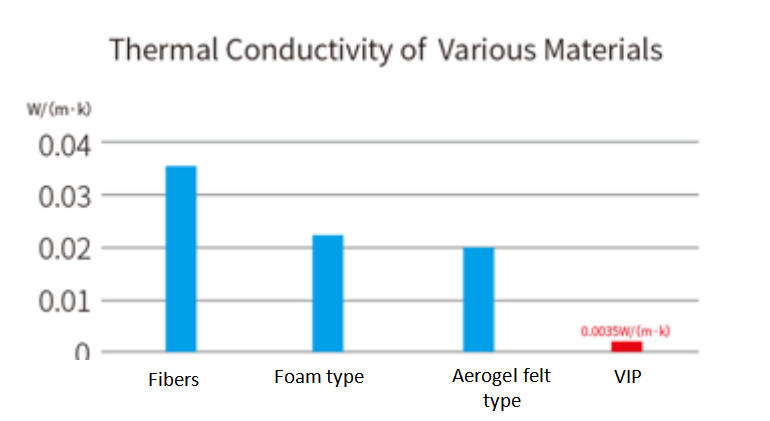
Figure 1. Thermal insulation performance of four types of thermal insulation materials
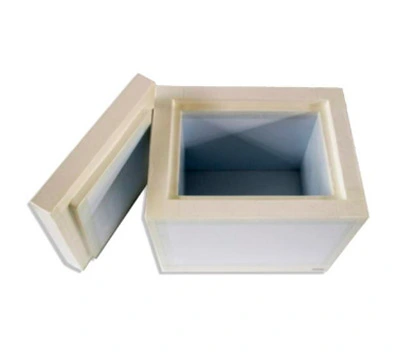
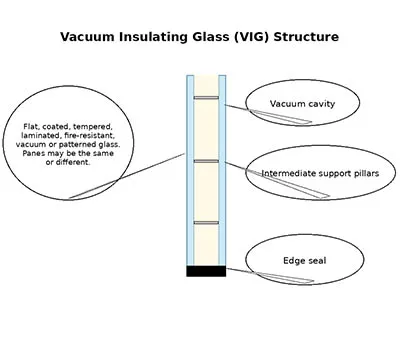
The vacuum insulation panel (VIP) product is shown in Figure (2). It is a new generation of highly efficient heat insulation material. The core material is fiber or powder type. The high-barrier coating film material ensures vacuum airtightness. Good heat insulation is achieved by effectively isolating gas heat conduction through vacuuming. The product has an extremely low thermal conductivity coefficient. The heat insulation structure is compact, with a thickness of only 1/8 to 1/10 of that of traditional materials. It does not absorb water and is resistant to acid and alkali corrosion. The product has been widely used in home appliances, chemical industry and new energy fields. The low thermal conductivity and low temperature diffusion coefficient features of the special VIP products offer options for the compact design of new energy batteries and further enhanced safety.
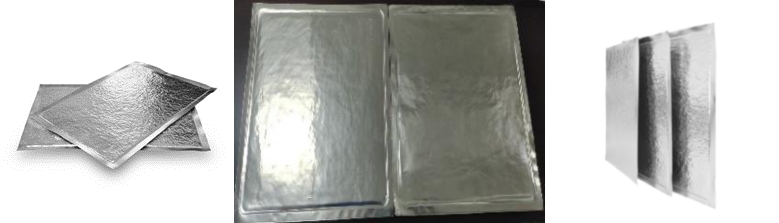
Figure 2. vacuum insulation panel(VIP)
Metal VIP uses aluminum foil or stainless steel foil as the film material, basalt fiber, high-silica oxide, etc. as the core material. After vacuuming, it is encapsulated by welding. The product features resistance to high and low temperatures, low thermal conductivity, stable performance, puncture resistance and A-level fire resistance and non-combustibility. It is another preferred high-efficiency thermal insulation material in addition to high-silica fiber and aerogel felt. Its main indicators are shown in Table (1).
Table1. Main performance indicators of metal VIP
Central thermal conductivity(25℃) | <3 mw/(m·k) |
Gram weight (1.5mm thickness) | 1.3-2.0 kg/m2 |
Integral leak rate test | ≤10-10Pa.m3/s |
Applicable temperature range | -253-1000℃ |
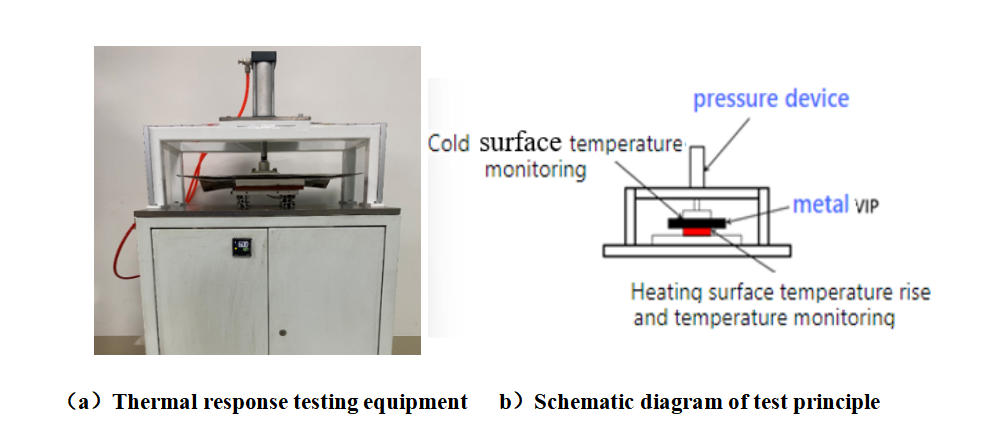
Figure 3. Temperature response test device
To evaluate the non-steady-state characteristics of the heat transfer process in the wide temperature range of metal VIP, the temperature responses of the cold and hot surfaces were measured using the test apparatus as shown in Figure (3). When the hot surface (heating surface) is maintained at high temperatures of 200℃, 400℃, and 600℃, the temperature of the cold surface gradually increases over time as shown in Figure (4), reaching 23.4℃, 26.8℃, and 123.1℃ respectively. Below 400℃, the temperature of cold surface is almost the same as that of room temperature. Even at a high temperature of 600℃, metal VIP still demonstrates excellent heat insulation performance. The temperature of the cold side is only 123.1℃, and the temperature difference between the hot and cold sides reaches 476.9℃. The 8mm thick metal VIP exhibits excellent heat insulation performance in a wide temperature range.
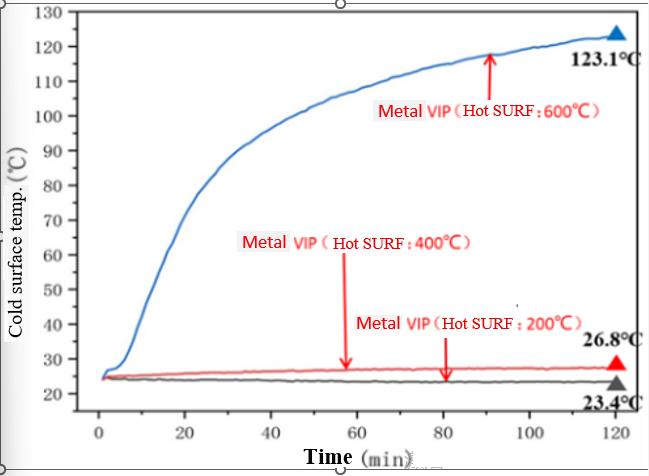
Figure 4. Temperature response curve of the cold surface of the sample
The interior of the metal VIP is filled with high-temperature resistant core materials and vacuumed, demonstrating excellent heat insulation performance in a direction perpendicular to the metal VIP. The external covering material is made of stainless steel foil. The heat transfer process of this unique "heat dissipation - heat insulation - heat dissipation" structure of the metal VIP presents two-dimensional heat transfer characteristics, as shown in Figure (5). From the results of the thermal imaging figure (6), it can be seen that the surface temperature of the metal VIP will rapidly spread and decrease in all directions with the heating zone as the center. It has a good heat dissipation effect in the direction parallel to the board surface. If the covering material is selected as a high thermal conductivity material such as aluminum foil and connected to the heat dissipation system of thermal management, due to the good heat insulation in the direction perpendicular to the board surface, the heat transfer between the battery cells is greatly reduced. Significantly delay temperature diffusion, effectively transfer the accumulated heat through the parallel plate surface direction and carry it away through the heat dissipation system, or effectively reduce its thermal load, thereby achieving good battery thermal management.
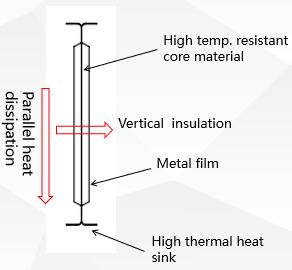
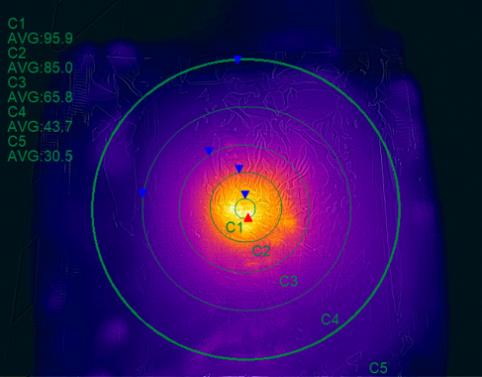
Figure 5. Two-dimensional heat transfer schematic diagram of metal VIP Figure 6. Thermal imaging of the sample
The comparison test of the cold side temperature response of 8mm thick metal VIP and 9mm thick aerogel felt with the same length and width under the conditions of 400℃ and 600℃ on the hot side is shown in Figure (7). Compared with the aerogel felt, the cold side temperature of metal VIP is significantly lower, with the differences being 148.4℃ and 204.8℃ respectively. During the rapid heating (non-steady-state) process where the hot surface is continuously heated from room temperature to 200℃ and 400℃, the temperature of the metal VIP cold surface also shows significant differences from that of the aerogel felt. The temperature responses of its cold and hot sides are shown in Figure (8). Therefore, due to the lower thermal conductivity or thermal diffusion coefficient of metal VIP, the speed of temperature propagation or diffusion is significantly slowed down, providing a longer safe escape time for battery thermal runaway or greatly reducing the thermal load of the thermal management cooling system. For ternary lithium batteries, the maximum thermal runaway temperature of the battery cells can reach 700-800℃. Currently, in the industry, 2.5mm aerogel pads are generally used for thermal runaway isolation (requiring the temperature of adjacent cells to be controlled within 200℃). The use of metal VIP can effectively reduce the thickness of the aerogel, freeing up more space and weight for the battery system. Table 2 compares and calculates the main parameters of two insulation methods, aerogel felt and metal VIP, for battery packs of specific sizes. Apart from an increase in overall weight, the thermal resistance of metal VIP is five times that of aerogel felt, and its thickness is significantly reduced, demonstrating a high cost-performance ratio.
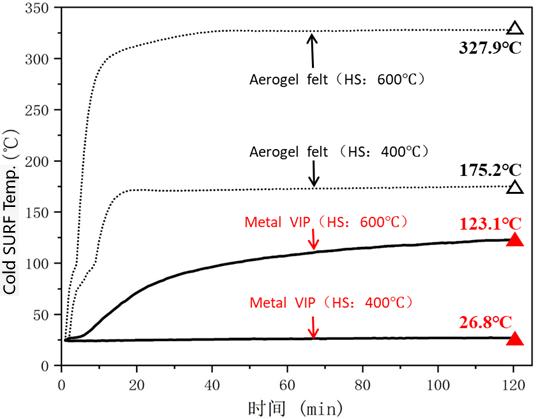
Figure 7. Temp response curves of the cold side of metal VIP and aerogel felt
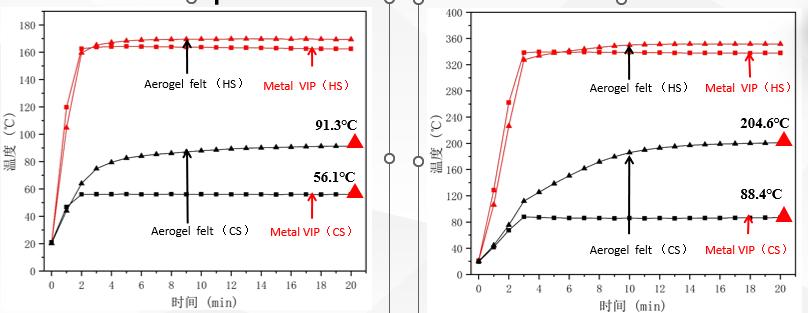
Figure 8. Temp response curves of the cold/hot surfaces of metal VIP and aerogel felt
Table2. The cost-effectiveness of two insulation methods for ternary lithium batteries
TLB | Size(mm) | Thickness(mm) | Qty (pcs) | Price (RMB/m2) | G.W. (kg/m2) | Rth(m2.k/w) |
Aerogel felt | 205*98 | 2.5 | 216.0 | 169 | 1.7 | 0.1 |
Metal VIP | 205*98 | 1.5 | 216.0 | 160 | 1.4 | 0.5 |
A large number of experiments have proved that the operating temperature of battery packs is significantly correlated with the retention rate of discharge capacity. As shown in Figure (9), it is the trend chart of the retention rate of discharge capacity and temperature of the mainstream lithium iron phosphate batteries in the market. As the temperature drops, the discharge capacity will decrease. Below -5℃, the discharge capacity will drop sharply, and at -20℃, it will be reduced by nearly 25%. This is also one of the important reasons why the range of new energy vehicles drops significantly in the low-temperature winter environment. At the same time, it solves the problem of users in the north complaining about the long fast charging time in winter. Therefore, the overall insulation of the battery pack is crucial for extending battery life, improving charging efficiency and user experience.
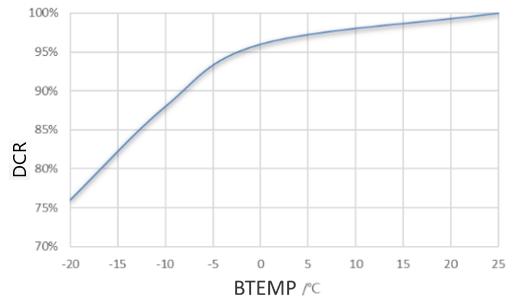
Figure 9. Relationship between the retention rate of battery pack discharge and temperature
Vacuum insulation ultra-thin VIP, with a thickness of only 1-5mm. The product has excellent heat insulation and buffering functions and has passed a series of tests and verifications required by the new energy industry. In particular, the "Double 85" environmental reliability test was carried out in accordance with the GB/T 2423.50 standard. Under the conditions of ambient temperature 85±2℃ and humidity 85±5%RH, The product underwent a 1000-hour aging test, and its thermal conductivity was still less than 8 mw/ (m·k), demonstrating its long-term ability to resist moisture penetration and the stability of its thermal performance. The main performance indicators are shown in Table 3. Batch products have been applied in fields such as thermal insulation and protection of power lithium battery packs.
Table3. Main performance indicators of ultra-thin VIP
Initial thermal conductivity | 3.5 mw/(m·k) |
Double "85" reliability test Thermal conductivity after 1000 hrs | ≤ 8 mw/(m·k) |
Copper acetic acid salt spray The change in thermal cond after 240 hrs | < 2 mw/(m·k) |
withstand voltage | 3800 VDC 漏点<1mA |
Insulation | 5000 MΩ,1000VDC |
A certain brand of battery pack uses the same 3mm thickness of thermal insulation foam and ultra-thin (Yinlin ultrathin™) VIP respectively for insulation treatment. The initial temperature is 25℃, and it is placed in a low-temperature environment of -20℃. Under natural convection, the temperature of the foam battery pack drops to 0℃ in about 3.5 hours. However, the battery pack using Yinlin ultrathin™-VIP took about 10 hours for its temperature to drop to 0℃. The cooling curve is shown in Figure 10, and the heat preservation time differed by more than three times, significantly enhancing the battery pack's adaptability to low-temperature environments and its battery life.
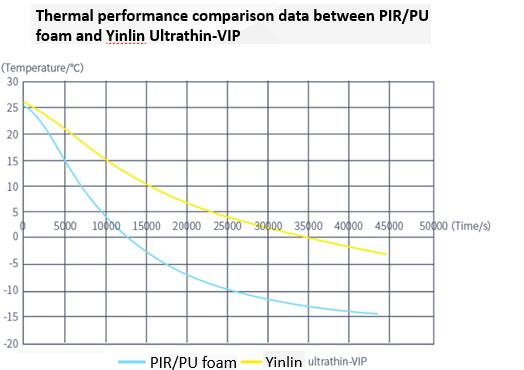
Figure 10. Battery pack cooling curve
The insulation of battery packs and the thermal management between cells in new energy batteries involve two completely different heat transfer processes: steady-state and non-steady-state. Therefore, the physical parameters of concern are significantly different. As mentioned earlier, the former involves energy conservation, while the latter involves safety. For the temperature control of battery packs, the insulation material and the battery pack are more in a steady-state or quasi-steady-state process of heat transfer. The heat transfer process is generally described by the Fourier equation, and the characteristic parameter involved is the Thermal Conductivity k value (Thermal Conductivity), that is, the heat transfer capacity under a determined temperature distribution. The temperature control between new energy battery cells, especially the Thermal runaway process, belongs to non-steady-state heat transfer, focusing on the dynamic changes in temperature. It is usually characterized by the Thermal Diffusivity a value or the thermal conductivity coefficient. Its physical meaning refers to the ability of each part of an object to tend to have a consistent temperature during (rapid) heating or cooling processes. The thermal inertia of the object is displayed. The smaller the thermal diffusion coefficient, the greater the thermal inertia, and the slower the object reaches the state of thermal equilibrium. Specifically, the thermal diffusivity (a=k/ρ×Cp) reflects the comprehensive relationship between the heat conduction capacity (k) of the material during the heat conduction process and the heat storage capacity (ρ×Cp) of the substances along the way. The thermal diffusivity varies greatly among different materials. For instance, wood has a thermal diffusivity of 1.5×10⁻⁷ m2/s, while aluminum has a thermal diffusivity of 9.5×10⁻⁵m2/s. Generally, the smaller the thermal conductivity, The greater the density, the smaller the thermal diffusivity, and the greater the thermal inertia of the material. Table 4. It is the range of thermal diffusivity of different materials. Obviously, metal VIP has a large thermal inertia and is particularly suitable for thermal management systems between battery cells.
Table 4. Thermal conductivity and thermal diffusivity of various materials at room temperature
Material | heat cond coefficient (w/m·k) | thermal diffusivity (10-6 m2/s) |
Metal | 4-420 | 3-165 |
Gas | 0.01-0.20 | 15-165 |
Non-metallic (with a few exceptions) | 0.17-70 | 0.1-1.6 |
Liquid (non-metallic) | 0.05-0.68 | 0.08-0.16 |
Common heat insulation material | 0.04-0.12 | 0.16-1.6 |
Aerogel felt | 0.016-0.025 | 0.05-0.08 |
Metal VIP | 0.003-0.010 | <0.01 |
In addition, at present, the thermal performance test of ultra-thin VIPs for battery thermal management still mainly focuses on the measurement of the central thermal conductivity k value. Most measuring instruments are based on national standards such as GB/T 10295, GB/T10294, and GB/T39704, or international standards such as ISO 8301, or ASTM C518. That is, calculating the k value through the Fourier equation of steady-state heat transfer is also the recommended standard arbitration method. However, most instruments are suitable for measuring products with a thickness greater than 10mm, and are not applicable to the measurement of the thermal performance of very thin insulation materials with a thickness less than 5mm. Moreover, ultra-thin VIP is usually only 1-3mm thick. Even under the same preload pressure, the relative error in thickness measurement is much greater than 10%. Moreover, the temperature difference between the two sides is relatively small, but the temperature measurement error is also very large, resulting in significant deviations in the measurement data among different instruments, with some even exceeding 100%, and they are not comparable. Therefore, for the evaluation of the insulation performance of ultra-thin VIP structures, it is more scientific and reasonable to use the temperature response curve of the hot side or the temperature rise of the cold and hot sides under the conditions of determined heat flux density and determined time intervals.
Vacuum insulation technology and products have been widely popularized in home appliances and other fields, becoming the only essential material for energy conservation, consumption reduction and maximum space utilization of refrigeration appliances such as refrigerators and freezers. Vacuum insulation for battery thermal management is still in its infancy. It requires in-depth product verification and product adaptability design based on the characteristics of battery thermal management systems. However, the designability of the shape and size of special vacuum insulation board products (VIP) or vacuum insulation structures (VIS), the flexible combination characteristics of membrane materials, core materials and vacuum sealing methods, as well as the unparalleled insulation performance, make it possible to integrate the design of heat dissipation, insulation, fire prevention or fire compartments in battery systems. The new vacuum insulation board products have great application potential in the thermal management of automotive batteries and energy storage systems.
[1] Zhang Liyu, et al. Basic Experimental Study on the Correlation between Lithium Battery Performance and Temperature [J]. Journal of Xi 'an Jiaotong University, 2018 ,52 (5):133-141.
[2] Sato N. Thermal Behavior Analysis of Lithium-ion Batteries for Electric and Hybrid Vehicles[J]. Journal of Power Sources, 2001, 99(1-2): 70-77.
[3] WILKE S, SCHWEITZER B, KHATEEB S, et al. Preventing thermal runaway propagation in lithium ion battery packs using a phase change composite material: an experimental study[J].Journal of Power Sources, 2017, 340: 51 − 59.
[4] Pesaran A A. Battery Thermal Models for Hybrid Vehicle Simulations[J]. Journal of Power Sources, 2002, 110(2): 377-382.
[5] Rui Xinyu, et al. Review on the Thermal Runaway Spread Problem of Lithium-ion Batteries [J]. Battery Industry,2020,24(3):193-205.
[6] Jiangxi Zhongmao New Energy Materials Technology Co., LTD. A high-temperature resistant heat insulation sheet: CN222039868U.2024.11.22.
[7] "GB 38031-2020 Electric vehicles traction battery safety requirements".
[8] "GB18384-2020 Safety Requirements for Electric Vehicles".
[9] "GB38032-2020 Safety Requirements for Electric Buses".
 English
 日本語
日本語 한국어
한국어 français
 Deutsch
 Español
 italiano
 русский
 português
 العربية
 Türkçe