High heat is putting invisible stress on precision equipment. Nobody would park a precision instrument worth millions next to an oven. Yet in plenty of power plant control rooms, that is basically what happens every day.
DCS systems, relay protection devices, industrial computers — all highly temperature-sensitive, and none of them cheap.
A lot of power plants run into the same problem:
The control room stays hot, AC load keeps climbing, and precision equipment sits in elevated ambient temperatures for long periods.
Is the AC really the whole problem? The bigger issue is a high-temperature environment that has never been properly addressed.
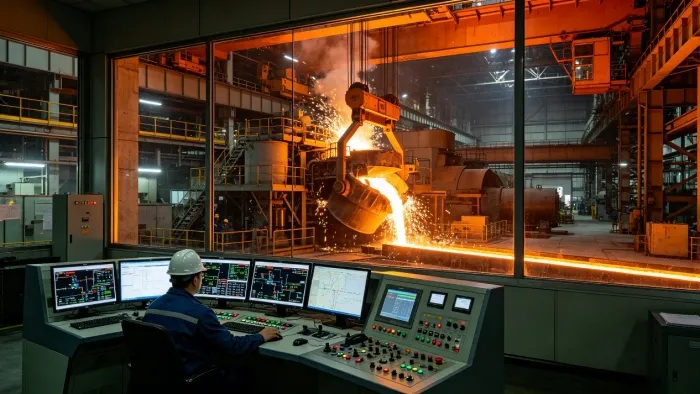
Most power plant control-room envelopes look something like this:
Walls: AAC blocks + external rock wool or glass wool
Glass: standard insulated glass in aluminum frames, sometimes upgraded to Low-E insulated glass
On paper, it looks insulated.
But how does it perform in the real world?
Existing solution | Parameter | Real-world problem |
Rock wool/glass wool wall | Thermal conductivity 0.036–0.050 W/(m·K) | Moisture uptake; fast decay; may fail in a few years |
Standard insulated glass | U-value 2.4–2.8 W/(m²·K) | Weak insulation; glass can easily exceed 50℃ |
Low-E insulated glass | U-value 1.4–1.8 W/(m²·K) | Better, but aging sealant makes performance unstable |
That setup may be fine for a normal building.
But in a power plant with constant heat, humidity, and corrosion, the real questions are:
How do you cut heat ingress?
How do you take long-term load off the AC?
How do you protect the precision equipment inside?
Loss No. 1: Equipment
For every 10℃ rise in electronic equipment operating temperature, the failure rate doubles.
— ARRHENIUS equation, a standard reliability model in the electronics industry
Drop the control-room temperature from 32℃ to 22℃:
Theoretical equipment failure rate drops by 75%
Cooling fans run slower, extending bearing life
Fewer unplanned shutdowns
Avoiding even one shutdown can save far more than the total insulation-upgrade cost
Skipping the insulation upgrade may look cheaper, but you are paying for it with equipment life.
Loss No. 2: People
Above 28℃, cognitive performance and reaction speed begin to drop.
Above 32℃, the error rate rises significantly.
Control-room operators have to stay locked in for long periods while monitoring hundreds of parameters.
In a power plant, one wrong move in a high-temperature environment can be serious. Enough said.
Equipment ages faster in heat. People make more mistakes in heat. The AC runs overloaded in heat. And the power bill stays high month after month. None of this means the equipment is bad or the operators are unprofessional.
It means the control-room insulation was never solved at the source. The wall insulation absorbs moisture and loses performance in the plant’s humid environment. The glazing sits at a U-value of 2.6W/(m²·K), letting a lot of heat pour in. There are two weak points. Leave either one open and the problem stays. So here are two answers, working together.
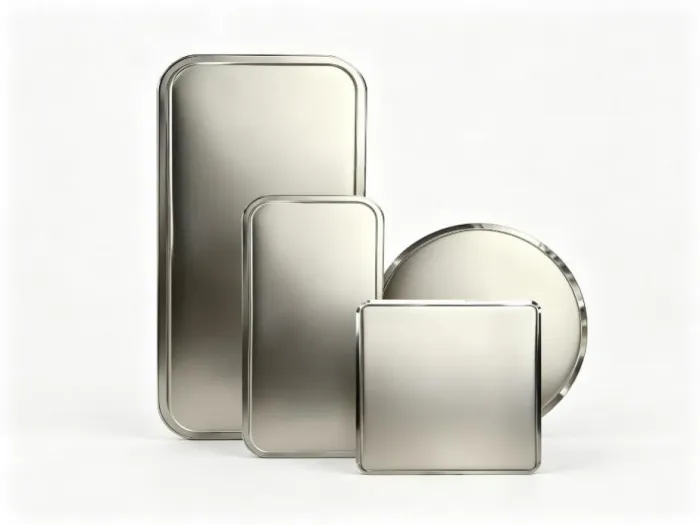
Designed for hot, humid industrial environments; used on control-room walls and ceilings
Comparison | Existing rock wool solution | ®VAP high-temperature metal vacuum insulation panel |
Thermal conductivity | 0.036–0.050 W/(m·K) | ≤0.005 W/(m·K) |
Suitability for humid power-plant environments | Poor; performance drops quickly after moisture absorption | Metal enclosure; moisture- and corrosion-resistant |
Installation thickness | 100–150mm | 15–25mm |
Service life | 10–15 years (shorter after moisture exposure) | Stable for ≥25 years |
Long-term maintenance cost | Requires regular inspection and replacement | Metal enclosure; maintenance-free |
On the key metrics, Supertech®VAP high-temperature metal vacuum insulation panels are built for hot, humid power-plant environments. Thermal conductivity is ≤0.002~0.004 W/(m·K), about 18–25 times lower than conventional rock wool; installation thickness is reduced by about 80%. The metal enclosure also improves moisture resistance, corrosion resistance, and long-term stability, cutting maintenance pressure from aging and moisture while giving the control room longer-lasting thermal protection.
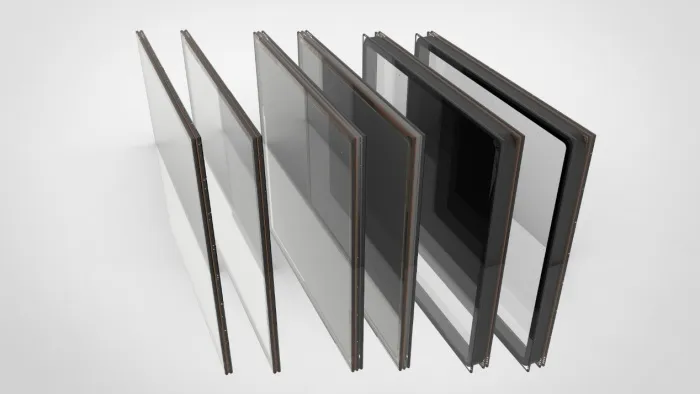
For control-room observation windows and duty-room glass partitions
Comparison | Existing Low-E insulated glass | SuperVIG® vacuum glass |
U-value | 1.4–1.8 W/(m²·K) | ≤0.6 W/(m²·K) |
Glass surface temperature (outdoor 50℃) | About 38–42℃; operators clearly feel the radiant heat | Significantly lower; radiant heat eliminated |
Sound insulation | 30–35 dB | ≥40 dB |
Seal durability | Butyl seal ages in 5–10 years | Dual seal; long-term stability |
Vacuum-cavity leak rate | — | ≤10⁻¹⁰ Pa·L/S |
The data shows that SuperVIG® vacuum glass sharply cuts heat transfer through glazed areas. Its U-value can reach ≤0.6 W/(m²·K), about 2–3 times lower than conventional Low-E insulated glass. A dual-seal structure improves long-term stability, while the vacuum-cavity leak rate reaches ≤10⁻¹⁰ Pa·L/S, reducing performance loss from seal aging and giving the control room more stable thermal and acoustic insulation.
What changes | Quantified reference |
Indoor temperature | Drops significantly; AC load falls sharply |
Equipment failure rate | Every 10℃ drop in temperature cuts the failure rate by 50% |
Operator efficiency | A 6℃ temperature drop raises efficiency by about 12% |
Annual electricity cost | Energy savings above 30% |
Insulation-system service life | Extended from 10–15 years to more than 25 years |
Block the heat, and both equipment and people can operate with less stress.
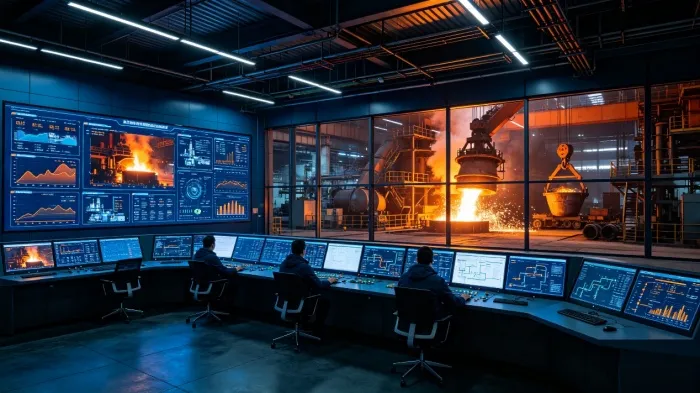
Precision instruments deserve better protection.
Operators deserve a more comfortable, reliable workplace too.
Supertech®VAP high-temperature metal vacuum insulation panels with thermal conductivity ≤0.002~0.004 W/(m·K), plus SuperVIG® vacuum glass with a whole-window U-value ≤0.6 W/(m²·K), create one high-performance thermal barrier across both walls and glass in the power plant control room.
This is more than a material upgrade. It is long-term protection for equipment stability, operator conditions, and energy-management efficiency.
Supertech VAP × SuperVIG® — upgrading industrial insulation with vacuum technology.
Tap to explore thermal-insulation solutions for the power industry
DM “Power Plant Solution” for a tailored technical assessment
 English
 日本語
日本語 한국어
한국어 français
 Deutsch
 Español
 italiano
 русский
 português
 العربية
 Türkçe