At four o'clock in the early morning, the outdoor temperature drops below zero.
On the park monitoring screen, the temperature curve inside the greenhouse is gradually sliding downwards.
The heating equipment kicks in with a buzzing hum.
This sound turns into figures on the utility bill at the end of every month.
More troublesome than fuel costs is the daytime trade-off:
Covering materials adopted for thermal insulation compromise light transmittance.
Crop photosynthesis declines accordingly, fruit ripening slows down, and yield begins to fluctuate.
Professionals engaged in protected agriculture are quite familiar with this dilemma:
Light transmission or thermal insulation. It seems one must always be sacrificed for the other.
Prioritize light transmission: ordinary glass and plastic films allow abundant sunlight in, yet heat escapes rapidly at night.
Prioritize thermal insulation: double-layer hollow covering materials retain part of the heat, yet each additional layer reduces light intake.
For decades, the industry appeared to have only these two options.
The conflict stems from two equally critical requirements:
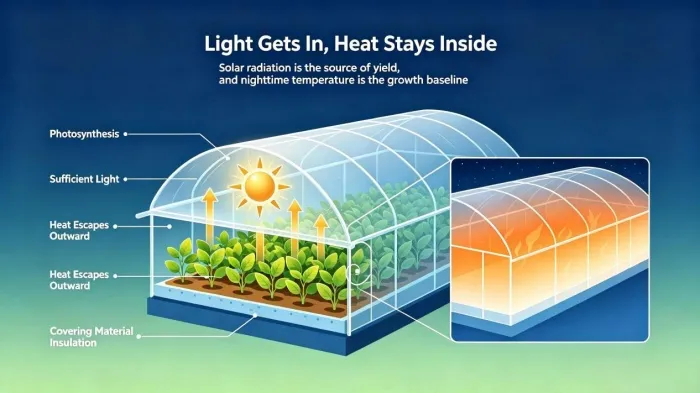
Light inside greenhouses: solar radiation drives photosynthesis, and light is the source of crop yield.
Cold resistance inside greenhouses: heat escapes outward through covering materials during nighttime, and temperature is the prerequisite for crop growth.
Why do conventional materials always create conflicts between these two factors?
The root lies in the traditional thermal-insulation logic:
Traditional thermal insulation = adding barrier layers.
Films and single-layer glass feature good light transmission yet offer minimal heat retention.
Double-layer hollow structures improve thermal performance by adding thickness and extra layers, but every added layer absorbs part of the incoming light.
As long as thermal insulation relies on stacked layers, the conflict between light transmission and thermal insulation remains unsolvable.
Vacuum glass adopts a completely different working principle.
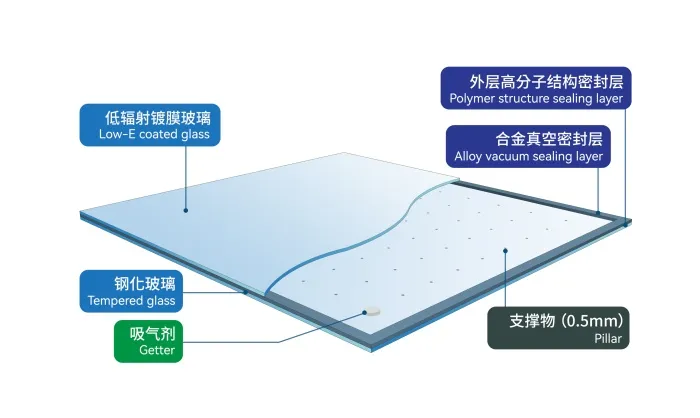
Instead of relying on air layers for heat insulation between two glass panes, the interlayer is evacuated into vacuum.
Only ultra-thin supporting gaps are reserved. Combined with low-emissivity coatings and getters, long-term vacuum stability is maintained.
This is the key advantage:
No air molecules exist within the vacuum layer for heat conduction.
Major heat-loss pathways are blocked. Thermal insulation performance is achieved without extra stacked layers.
The glass maintains its original light-transmitting capacity.
Heat stays trapped inside the greenhouse while sunlight penetrates freely, with no mutual interference between the two functions.
To summarize this transformation:
Traditional materials trade light for heat, while vacuum glass delivers both light transmission and thermal insulation.
The heat-transfer coefficient (U-value) can reach below 0.42 W/(m²·K), equivalent to 1/4 to 1/3 of comparable insulating glass.
In practical operation terms:
Night-time heat loss is greatly reduced. Heating equipment operating hours and fuel expenses can be substantially cut.
Take the SuperVIG series as an example:
Visible light transmittance: optional within 40%-75%
Solar heat gain coefficient (SC value): 0.3-0.6
These parameters function like custom-fitted glasses for crops:
High-temperature summer regions: select low SC value. Strong solar-radiation blocking prevents overheating inside greenhouses and lowers shading and cooling costs.
Zones prioritizing winter thermal retention: choose high-transmittance configurations to maximize daytime solar intake and save electricity for artificial supplementary lighting.
Light transmittance and solar heat gain coefficient can now be precisely matched to crop requirements and local climate conditions.
Parameter | Range |
Nominal Thickness | 6.5-38.5 mm |
Width | 250-1500 mm |
Length | 500-2500 mm |
Operating Temperature | -60℃-100℃ |
The lower temperature limit of -60℃ covers winter-survival scenarios in cold northeast and high-altitude regions. Custom special sizes are available according to greenhouse structures.
Service life: over 20 years.
Compare this with traditional covering materials:
Film-type materials require seasonal or annual replacement. Each replacement brings material expenses, labor costs and production downtime losses superimposed together.
Vacuum glass requires one-time installation with significantly reduced maintenance frequency and overall full-cycle costs.
Production capacity guarantee: The annual vacuum-glass production capacity of Xiamen base exceeds 2,000,000 square meters.
Small-batch sample production for individual pilot projects is supported.
Large-scale bulk supply for multi-span greenhouses is also available.
Roof and side walls constitute the main heat-loss areas all year round. After retrofitting with vacuum glass, night-time thermal insulation improves greatly, reducing heating equipment runtime and energy consumption.
Projects with high daylight requirements. Adjust visible-light-transmittance parameters to strike a balance between thermal insulation and light transmission matching local climate and crop varieties.
Utilize the wide operating temperature range of -60℃-100℃ for adaptive configuration. Under extreme weather conditions, covering materials will no longer be the first component to fail.
The essence of agriculture is converting sunlight into yield.
Light and heat are not cost burdens, but sources of production output.
When covering materials no longer force you to choose between the two:
Greenhouses truly start saving costs in winter.
Crops inside truly start generating profits.
This decades-old dilemma can finally be put to rest.
Follow the official WeChat account of SuperVIG. Provide greenhouse structure and local climate data. We assist in calculating suitable glass specifications and light-transmission combinations to find the optimal solution for your project.
 English
 日本語
日本語 한국어
한국어 français
 Deutsch
 Español
 italiano
 русский
 português
 العربية
 Türkçe