At a convenience store, a customer stops in front of the refrigerated cabinet.
He bends down, pressing his face almost against the glass door, squinting to look inside.
It is not the goods that attract him.
The fog-covered door turns the shelves into frosted glass.
Store managers are all too familiar with this scenario: the first task every morning after opening is wiping the doors.
Yet fog returns within two hours after wiping.
If your team develops refrigerated cabinets, wine cabinets or display cabinets, you are likely familiar with such scenarios.
"Glass door fogging" repeatedly appears in after-sales complaints.
To reduce complaints, electric heating wires are installed inside door frames.
Power consumption rises, while energy-efficiency performance becomes unsatisfactory.
This solution has a contradictory logic: To solve problems caused by "excessive cold", the adopted measure is "adding heat".
A 24-hour-running "invisible electric heater" is used to compensate for insufficient thermal insulation.
It only treats symptoms rather than root causes, and you keep paying electricity bills for this makeshift fix.
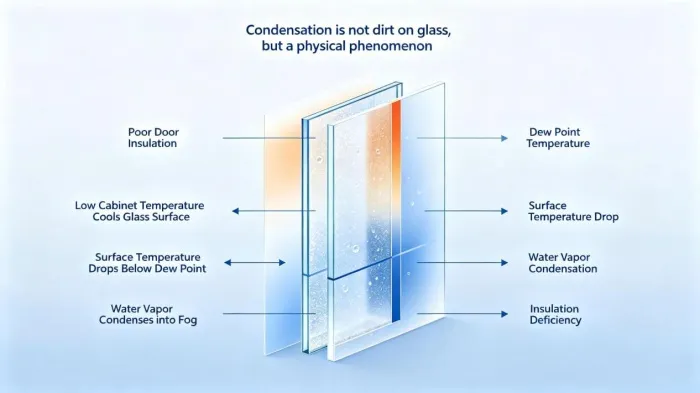
Condensation is not dirt on glass, but a physical phenomenon.
When the glass surface temperature drops below the dew-point temperature of ambient air outside the cabinet, water vapor condenses.
Poor door thermal insulation → low cabinet internal temperature cools down glass surface → surface temperature falls below dew-point → condensation occurs.
There is only one root cause: the U-value.
The lower the door heat-transfer coefficient, the closer the glass surface temperature gets to room temperature, and the further it stays from the dew-point.
Fog loses the conditions to form.
This is the fundamental solution: instead of fighting against dew-point, directly reduce the door U-value.
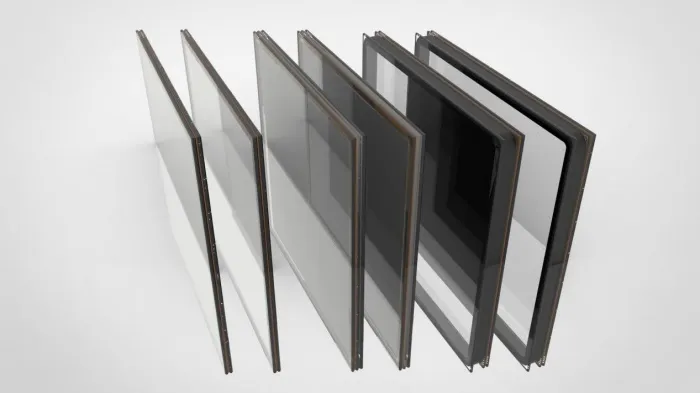
A vacuum gap is created between two glass panes. Combined with alloy sealing and low-emissivity coatings, heat transfer at glass center is eliminated at source to lower the U-value.
Insulation performance ranking: Glass-fibre-reinforced profile > PVC profile > Aluminium alloy profile
Different combinations can be selected according to project budget and energy-saving targets.
What do display cabinets and wine cabinets pursue? Transparency.
Narrower frames and larger glass viewing areas are preferred.
Frameless door adopts crystal coated glass plus vacuum glass, assembled into integrated door via labyrinth-type sealing structure.
Frame width is minimized while display area is maximized, without obvious loss of edge thermal insulation performance.
It is especially suitable for high-visibility display applications such as pharmaceutical refrigeration, wine storage and ice-cream cabinets, where visual appearance drives sales.
Calculated based on standard 1800 × 600 mm door under working condition of 20 ℃ and 65 % relative humidity. Performance comparison of framed door configurations is shown below:
Door Frame & Glass Combination | Overall U-Value W/(m²·K) | Condensation Performance |
Fibre-reinforced profile + vacuum glass | 0.52 | No condensation |
PVC profile + vacuum glass | 0.54 | No condensation |
Aluminium alloy profile + vacuum glass | 0.65 | Condensation on outer frame and frame-glass junction |
Fibre-reinforced profile + triple-glazed dual-cavity TPS insulating glass | 1.38 | No condensation |
Aluminium alloy profile + triple-glazed dual-cavity TPS insulating glass | 2.82 | Condensation on outer frame and frame-glass junction |
R&D teams may analyze this table from two perspectives:
Performance gap: The worst-performing solution (2.82) is over 5 times higher than the optimal solution (0.52). Condensation occurs exactly at outer frame and joints, which are within customers' primary field of view.
BOM cost: When U-value drops to 0.52-0.54, condensation is fundamentally eliminated. Electric heating wires can be directly removed from BOM list.
This cuts not only operating electricity costs, but also material costs, assembly labor hours and after-sales complaint cases.
One component selection brings three-fold cost savings.
Contact SuperVIG technical team if your team is working on:
Product R&D or procurement for household appliances and cold-chain equipment;
Matching frame material and glass combinations;
Customized specifications and stable delivery schedule requirements.
Provide door dimensions and operating temperature range. We assist you in determining optimal configuration and support customized specifications and delivery schedules.
For end-users, fog only means poor visibility.
For enterprises, fog translates into electricity bills, higher complaint rates and lost purchasing intent.
The best anti-fog solution is never wiping fog away.
It is to remove the physical conditions for fog to form.
 English
 日本語
日本語 한국어
한국어 français
 Deutsch
 Español
 italiano
 русский
 português
 العربية
 Türkçe