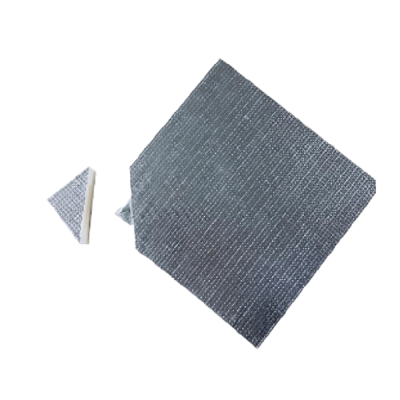
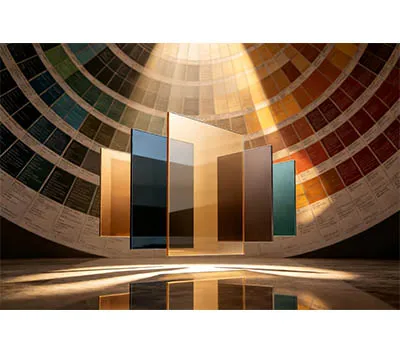
Solar-control coated glass. A coating changes the optical properties of the glass, selectively reflecting and absorbing solar radiation in the 300nm-2500nm range.
It is divided into offline and online solar-control coated glass.
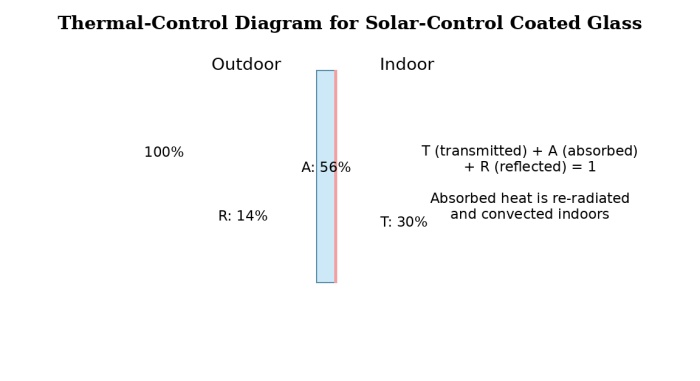
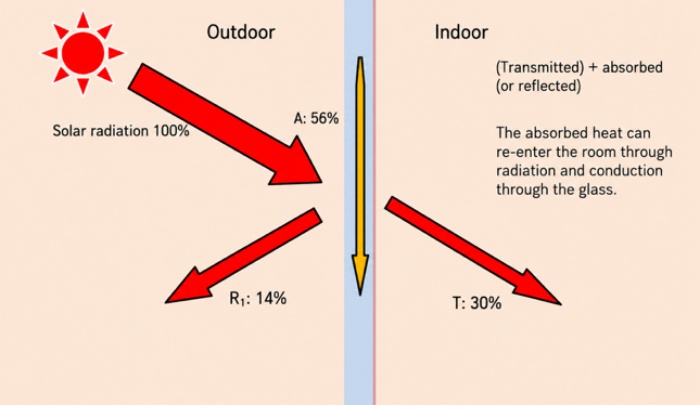
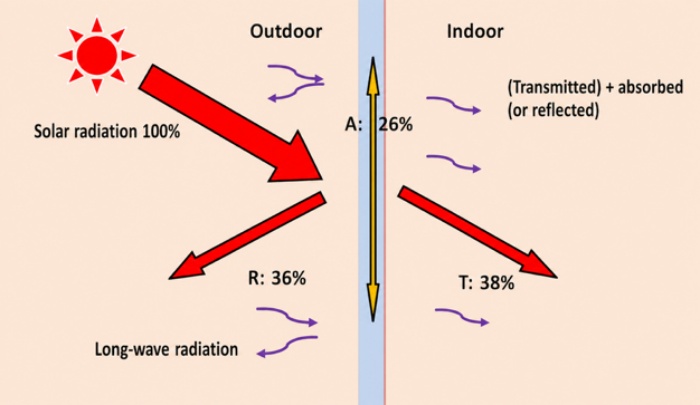
Solar-control coated glass mainly reduces direct solar transmission by reflecting a high proportion of sunlight. The coating material also strongly absorbs solar energy, raising the glass temperature. Because the coating has high surface emissivity, much of the absorbed heat is radiated indoors as secondary heat transfer. The result is low direct solar transmittance but a relatively high total solar heat gain coefficient.
Its surface reflectance is also limited to below 30% to control light pollution. Because the coating has a high E-value and provides almost no infrared reflection, its overall thermal-insulation performance is moderate.
Key metrics: g-value and SC. Typical performance of monolithic coated glass
U-value | SC | g(SHGC) | Visible light | Solar energy | |||||
Tv | Rf | Rb | Ts | Rf | Rb | Abs1 | |||
4.92 | 0.50 | 0.43 | 0.32 | 0.17 | 0.21 | 0.30 | 0.14 | 0.24 | 0.56 |
Low-emissivity coated glass. A coating changes the surface emissivity and optical properties of the glass, providing high infrared reflectance over wavelengths of 4500nm-25000nm. It is commonly called Low-E glass.
By production process, Low-E glass is divided into offline and online products. Offline Low-E glass is further classified by the number of functional silver layers as single-silver, double-silver and triple-silver Low-E glass.
Thermal-Control Diagram for Low-E Coated Glass
A low-emissivity functional coating reduces the glass surface emissivity and strongly reflects infrared energy, limiting infrared heat transfer indoors. By controlling coating thickness, it can also adjust selective solar transmission and absorption.
Key metrics: E-value (emissivity), with offline Low-E≤0.15 and online Low-E≤0.25; and SC (g-value). Typical performance of monolithic double-silver Low-E glass
U-value | SC | g(SHGC) | Visible light | Solar energy | |||||
Tv | Rf | Rb | Ts | Rf | Rb | Abs1 | |||
3.09 | 0.475 | 0.413 | 0.68 | 0.10 | 0.06 | 0.38 | 0.35 | 0.37 | 0.26 |
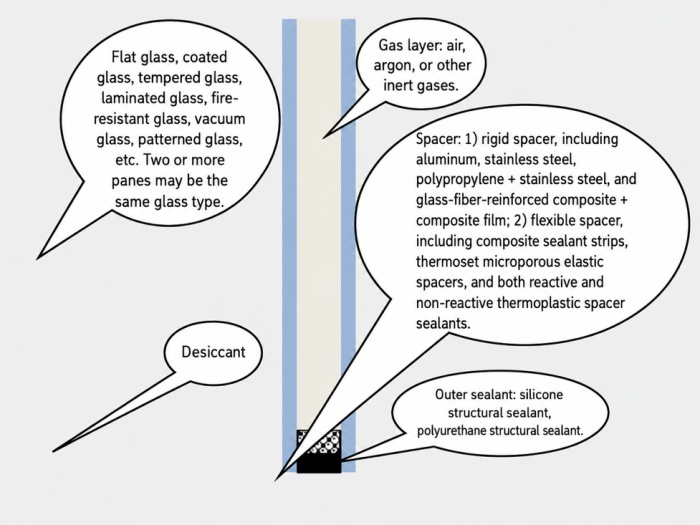
An insulating glass unit consists of two or more panes of glass, or other transparent materials, uniformly separated by effective supports and sealed around the perimeter to form an effective dry gas space between the panes. The system structure is shown below:
Heat Transfer Through an IGU
Spectral-optical performance: transmission, reflection, absorption, shading, visible light and total solar transmittance. Model boundary: solar radiation only, with outdoor and indoor reflectance assumed to be zero.
Thermal performance: gas-layer convection, radiation, installation angle and overall thermal transmittance. Boundary condition: no solar radiation in the thermal calculation.
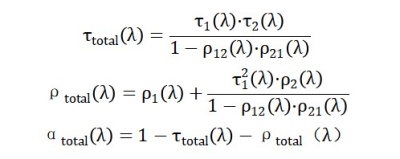
τtotal(λ), ρtotal(λ) and αtotal(λ) are spectral transmittance, reflectance and absorptance, and their sum equals 1 under the law of conservation of energy. τ1(λ) and τ2(λ) are the spectral transmittance of the front and rear panes. ρ12(λ) and ρ21(λ) are the cavity-side spectral reflectance of the front and rear panes.
Total solar heat gain coefficient g (SHGC) = direct solar spectral transmittance + secondary inward heat transfer from heat absorbed by the glass
That is:
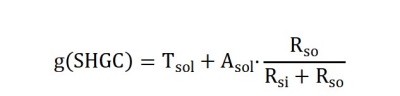
Using the standard indoor and outdoor surface heat-transfer coefficients specified in China, the equation becomes a function of fixed coefficients, transmittance and absorptance:

Substituting into the SC formula gives:

The equations show that the following factors affect the solar heat gain coefficient, or SC, of an IGU:
The g-value is positively correlated with the direct solar transmittance of the two or more panes forming the IGU.
Once glass transmittance is fixed, the g-value depends on the reflectance of the four glass surfaces, because reflectance determines absorptance at a fixed transmittance.
According to the SC formula and the coated-glass types described above, SC is independent of surface emissivity. Solar-control coated glass can therefore achieve the same SC as Low-E glass.
The thermal performance of an IGU, meaning insulation with no solar radiation, consists of three parts: solid heat transfer through the glass, convective heat transfer across the gas cavity and radiative heat transfer across the gas cavity.
For solid conduction, the standard thermal conductivity of glass is generally taken as 1W/m·K. Once the number of gas cavities is fixed, the controlling factor for solid heat transfer is the thickness of the glass in the system.
For vertically installed glass, the tilt angle is 0°:
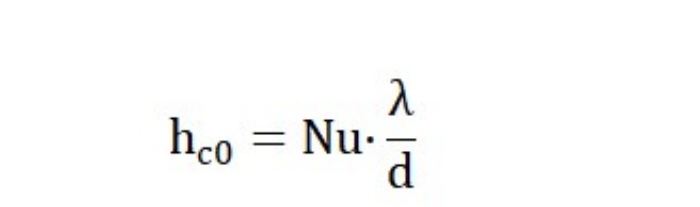
d: gas-cavity thickness (m)
λ: thermal conductivity of the cavity gas, W/m·K
Nu: Nusselt number, a function of the Rayleigh number Ra, the cavity height-to-thickness ratio and the cavity tilt angle θ.
The Rayleigh number is the product of the Grashof number and Prandtl number:

Gr: Grashof number, or buoyancy criterion. Natural convection in the IGU gas cavity is driven by temperature-induced buoyancy, with characteristic length based on cavity thickness d:

g: gravitational acceleration, 9.81m/s2; volumetric expansion coefficient β=1/Tm, the reciprocal of average gas temperature in 1/K; ΔT: temperature difference between the two glass surfaces across the gas cavity in K; d: gas-cavity thickness in m; ν: gas kinematic viscosity in ㎡/s.
Pr: Prandtl number, a dimensionless combination describing the interaction of energy and momentum transport and the relationship between thermal and velocity boundary layers. It depends only on the gas and its temperature. Once the cavity gas is fixed, Pr is constant. Typical values are 0.703 for dry air, 0.680 for argon Ar and 0.67 for krypton Kr. Other gases can be calculated from known gas properties using the following method, which may also be combined with the Gr equation.
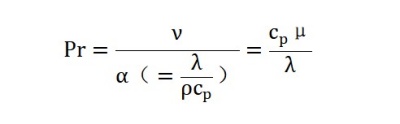
cp: gas specific heat at constant pressure (J/kg·K); μ: dynamic viscosity (Pa·s); λ: gas thermal conductivity (W/m·K); ρ: gas density; ν=μ/ρ.
When the glass is tilted from the vertical, the tangential buoyancy component of gravity along the heat-transfer surface decreases, while the normal component suppresses convection cells. Overall convective intensity decreases as the tilt angle increases.
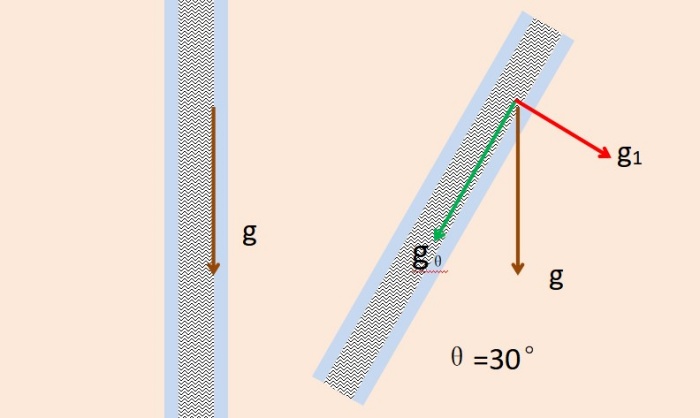
As shown, increasing the glass tilt reduces the gravitational acceleration that drives convection.
gθ=gcosθ
Equivalent Rayleigh number under tilted conditions:
Raθ=Ra0cosθ
Under ISO15099 and GB/T2680, when the glass installation angle increases from 60° to 90°, the tangential gravity component falls sharply and convection cells are suppressed. Based on measured conditions, the equivalent Rayleigh number is corrected as follows. This correction applies only to IGU systems:
Nuθ=1+(Nu0-1)cos2θ
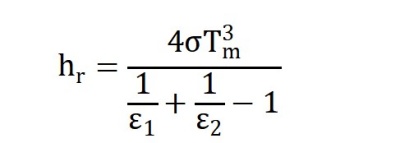
σ: Stefan-Boltzmann constant = 5.67×10⁻⁸W/(㎡·K4)
ε1 and ε2: emissivity of the two glass surfaces facing the cavity
Tm: average glass-surface temperature
IGU thermal resistance follows the series-addition principle:
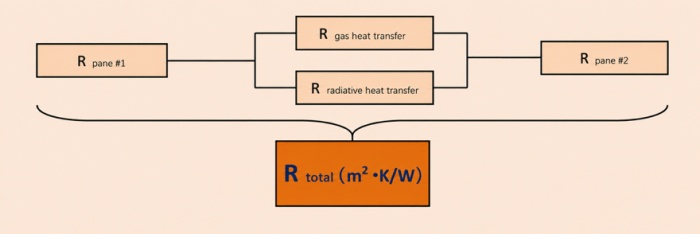
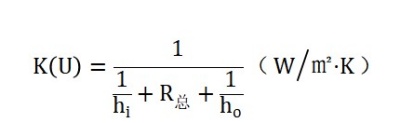
Base calculation data. The manufacturer measured the sample parameters with a spectrophotometer and calculated the spectral constants of each pane by spectral integration.
Clear glass: 6mm clear glass from CSG is used as the example. Parameters are as follows:
Solar parameters (Solar) | Visible light (Visible) | Emissivity (ε) | |||||||
Tsol1 | Tsol2 | Rsol1 | Rsol2 | Tvis1 | Tvis2 | Rvis1 | Rvis2 | ε1 | ε2 |
0.822 | 0.822 | 0.074 | 0.074 | 0.897 | 0.897 | 0.081 | 0.081 | 0.84 | 0.84 |
Low-E glass: CSG LB69-1_6 double-silver coated glass is used as the example. Parameters are as follows:
Solar parameters (Solar) | Visible light (Visible) | Emissivity (ε) | |||||||
Tsol1 | Tsol2 | Rsol1 | Rsol2 | Tvis1 | Tvis2 | Rvis1 | Rvis2 | ε1 | ε2 |
0.325 | 0.325 | 0.301 | 0.419 | 0.669 | 0.669 | 0.091 | 0.053 | 0.84 | 0.033 |
To strengthen the comparison between solar-control coated glass and Low-E glass, CSG CNY129_6 is used as the solar-control sample. Parameters are as follows:
Solar parameters (Solar) | Visible light (Visible) | Emissivity (ε) | |||||||
Tsol1 | Tsol2 | Rsol1 | Rsol2 | Tvis1 | Tvis2 | Rvis1 | Rvis2 | ε1 | ε2 |
0.292 | 0.292 | 0.137 | 0.239 | 0.322 | 0.322 | 0.17 | 0.214 | 0.84 | 0.664 |
Calculations using LBNL WINDOW 7.2 under the boundary conditions specified in JGJ/T 151:
Visible light transmittance, Tvis=0.603
Solar heat gain coefficient, g (SHGC)=0.363
Shading coefficient, SC=0.417
Light-to-solar-gain ratio, LSG=1.66
Thermal transmittance, K(U)=1.66 W/㎡·K
After replacing the Low-E glass with solar-control coated glass: Tv=0.294, g (SHGC)=0.35, SC=0.403, K(U)=2.51 W/㎡·K and LSG=0.84.
At similar SC values, the LSG of an IGU using solar-control coated glass is only half that of one using Low-E glass. This reflects the ability of Low-E glass to provide higher daylight transmittance while reflecting infrared heat. For the same solar heat entering indoors, Low-E glass admits more visible light, whereas solar-control coated glass achieves a similar SC by reducing visible light.
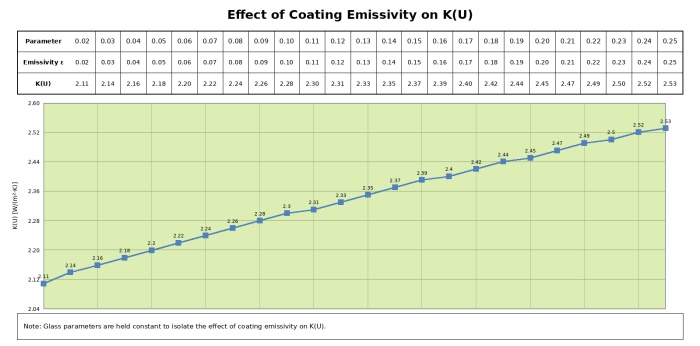
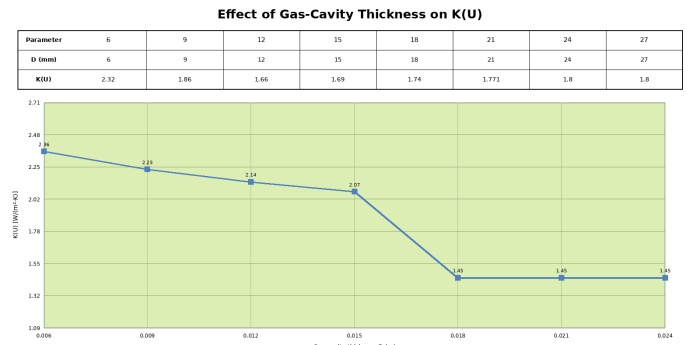
Based on the above calculations, the following analysis changes one IGU parameter at a time while holding the others constant, to determine its effect and degree of influence on thermal performance.
Changing coated-glass emissivity: assuming the coated surface emissivity varies from 0.02 to 0.25, the trend is as follows. K(U) increases as emissivity increases.
Changing gas-cavity thickness: as the cavity becomes thicker, convective heat transfer falls and K(U) decreases. At 12mm<d<16mm, the gas flow changes from laminar to transitional. Further increases in cavity thickness no longer produce a significant change in K(U). The optimum IGU cavity thickness is therefore 12mm, which is generally used in engineering.
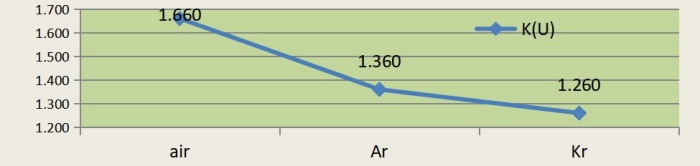
Changing the fill gas: as gas thermal conductivity decreases, the K(U) of the IGU also decreases.
Gas type | Dry air (air) | Pure argon (Ar) | Pure krypton (Kr) |
K(U) | 1.66 | 1.36 | 1.26 |
Trend chart |
| ||
These calculations identify three factors governing IGU thermal performance: the coated-glass properties, particularly surface emissivity; gas-cavity thickness; and the gas composition. Together they determine the system thermal transmittance, or K(U)-value.
Three Low-E glass specifications from CSG are used to show how spectral performance affects selection.
Glass | Solar parameters (Solar) | Visible light (Visible) | Emissivity (ε) | Notes | |||||||
Tsol1 | Tsol2 | Rsol1 | Rsol2 | Tvis1 | Tvis2 | Rvis1 | Rvis2 | ε1 | ε2 | ||
0.228 | 0.228 | 0.481 | 0.491 | 0.583 | 0.583 | 0.083 | 0.030 | 0.84 | 0.024 | Triple-silver | |
LB69-6 | 0.345 | 0.345 | 0.392 | 0.424 | 0.679 | 0.679 | 0.099 | 0.060 | 0.84 | 0.033 | Double-silver |
0.434 | 0.434 | 0.179 | 0.223 | 0.624 | 0.624 | 0.103 | 0.032 | 0.84 | 0.141 | Single-silver | |
Each IGU uses a 6Low-E+12A (air)+6C construction installed at 90° to the vertical plane. The optical performance of the three coated-glass products is calculated below:
Glass | Tv | Asol | g(SHGC) | SC | LSG |
0.524 | 0.318 | 0.260 | 0.3 | 2.02 | |
0.612 | 0.295 | 0.373 | 0.43 | 1.64 | |
CEB14-60 | 0.561 | 0.428 | 0.459 | 0.53 | 1.22 |
The three IGUs all fall within the medium-transmittance range. Their solar-blocking performance is triple-silver>double-silver>single-silver. Triple-silver glass has the lowest surface emissivity and strongly reflects the near-infrared range of 780nm-2500nm, while double-silver ranks second. At the same time, it allows more visible light through the system, giving it the best LSG.
Selection significance: triple-silver Low-E glass provides more daylight while blocking more solar energy from entering indoors, resulting in brighter interiors and lower cooling costs. Summer relative heat gain provides a direct comparison of the insulation performance of IGUs using the three glass types.
Glass type | SJ50s-6 | LB69-6 | CEB14-60 |
Relative heat gain (RHG) | 201 W/㎡ | 284 W/㎡ | 348W/㎡ |
Relative heat gain directly reflects overall summer thermal performance, combining indoor-outdoor convective heat transfer and transmitted solar energy. It provides a practical basis for selecting windows and doors for summer conditions: after the U-value and SC are set, the glazing system with higher visible light transmittance provides the best balance of daylight and insulation.
The above calculations provide a basic method for selecting an IGU system. A later article will discuss the factors affecting VIG performance, so installation angle is not covered here and will be addressed together with the VIG comparison. All thermal values in this article are calculated at 90° to the vertical plane. The coated glass is the outer pane, with the coating on surface #2.
Selecting coated glass with low surface emissivity makes a major contribution to IGU insulation. It not only reduces mid- and far-infrared heat transfer, reflected in K(U), but also lowers solar heat gain. Low-E glass reflects near-infrared solar radiation and therefore reduces total solar energy transmission.
Gas-cavity thickness and gas composition also affect final thermal performance. The preferred cavity thickness is 12mm. Argon (Ar) provides the best cost-performance balance, while xenon (Xe) provides the highest performance. The final evaluation metric is K(U).
Total solar transmittance determines the heat-gain performance of an IGU, meaning its ability to block or admit solar radiation. The basic reason for using glass is daylighting. Using this property inevitably allows some solar energy indoors; otherwise an opaque material would provide better solar blocking.
Selection by total solar transmittance can therefore be divided into two parts, because solar energy is mainly composed of visible light and near-infrared radiation.
Visible light transmittance Tv accounts for 44% of solar-spectrum energy. When indoor daylight requirements are met, a lower visible light transmittance reduces solar transmission and improves solar insulation. As a general guide, south-facing windows in southern regions may use Low-E glass with 45-60% visible light transmittance, balancing adequate daylight with lower total solar transmission. Shaded façades may use high-transmittance Low-E glass to maintain daylight.
On façades without direct sunlight, incoming heat is mainly far-infrared, so solar transmittance is not a thermal-insulation metric. Solar-control coated glass on a shaded façade provides no thermal-insulation benefit.
Near-infrared radiation accounts for 53% of solar energy and provides no benefit for summer insulation in hot southern climates. Ideally, none of it would enter indoors, although this cannot be fully achieved in practice. Low-emissivity glass is the preferred option for increasing near-infrared blocking.
The principal solar-insulation metric is total solar heat gain, or g-value. A lower g-value is better, but reducing it can conflict with visible light transmittance. Selection should therefore aim for the lowest practical g-value while meeting indoor daylight requirements.
LSG provides a direct optimisation metric. For example, if Tv is fixed at 55%, LSG=Tv/g=0.55/g. With a fixed numerator, a higher LSG means less solar energy enters indoors.
This discussion of IGU heat-transfer principles and the effects of component-glass properties provides a basis for optimising the IGU configuration to meet specific thermal-performance requirements.
References: JGJ/T151, GB/T2680, ISO15099 and other standards.
 English
 日本語
日本語 한국어
한국어 français
 Deutsch
 Español
 italiano
 русский
 português
 العربية
 Türkçe