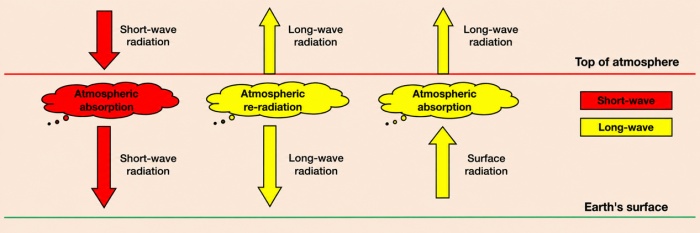
Solar radiation reaches the Earth’s atmosphere as electromagnetic waves. Long-wave radiation is absorbed by ozone, water vapour and other atmospheric components, while short-wave radiation reaches the surface directly. The absorbed long-wave radiation is re-radiated by the atmosphere: part reaches the surface and part escapes into space.
The portion of solar radiation reaching the surface that the human eye can detect is visible light, with wavelengths of 380nm-780nm. Wavelengths below 380nm are ultraviolet, while 780nm<λ<2500nm is near-infrared. Solar radiation reaching the Earth’s surface therefore spans 280nm-2500nm.
Energy Distribution of Solar Radiation at the Earth’s Surface:
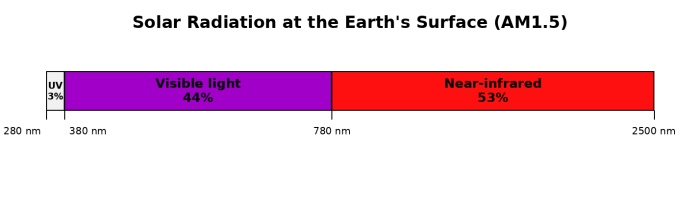
Solar radiation at the Earth’s surface is the main natural energy that insulating windows and doors block or use.
This category includes solar radiation absorbed and re-radiated by the atmosphere, secondary radiation from ground objects after they absorb sunlight, and radiation from space heating and heaters, including combustion and electric heaters. All are long-wave radiation with λ>4500nm.
Controlling or using long-wave radiation and solar radiation at the Earth’s surface is a primary function of insulating windows and doors.
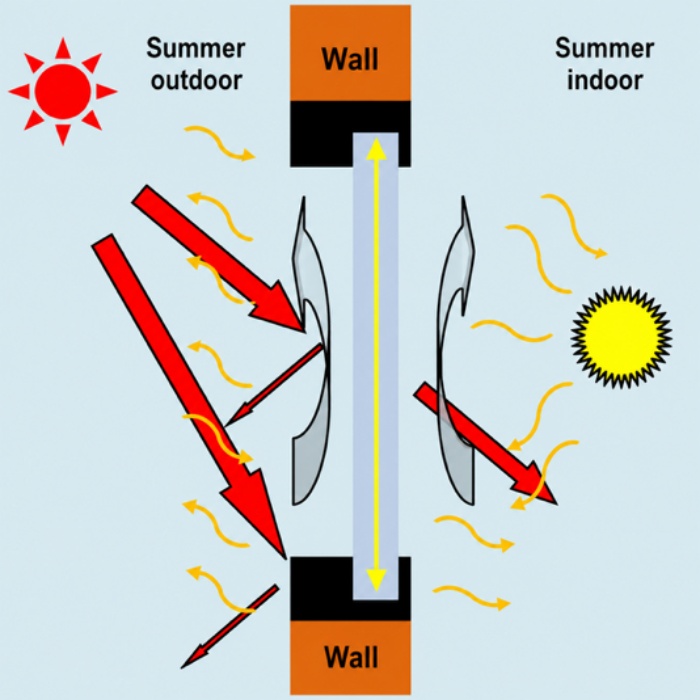
Summer heat transfer through windows and doors:
Frames: part of the heat is reflected, and part is absorbed by the frame, raising its exterior-surface temperature. Heat then conducts to the interior surface, which warms indoor objects by radiation and indoor air by heat exchange.
Glass: when sunlight strikes the glass, part is reflected, part passes directly indoors, and part is absorbed. The absorbed heat is then transferred again: some radiates to indoor objects or back outdoors, while some heats indoor air through heat exchange.
Hot outdoor air exchanges heat with the glass and frame, warming their exterior surfaces. Heat then passes inward by conduction, convection and radiation; the dominant mode of heat transfer depends on the window and door system. The heated interior surfaces warm the room by radiation and air convection.
Overall, heat flows from outdoors to indoors.
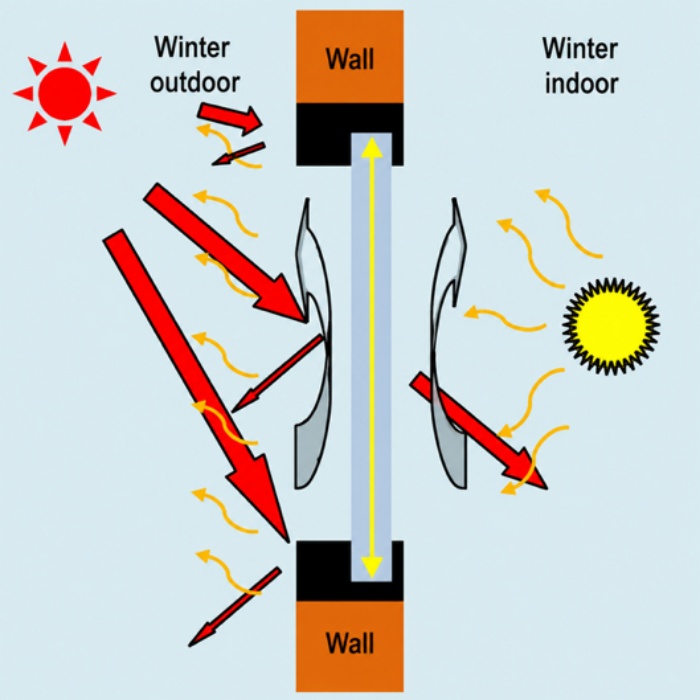
Winter heat transfer through windows and doors:
Sunlight still warms the outer frame. However, because indoor air is warmer than outdoor air, the net heat flow through the frame is from indoors to outdoors.
At the glass, part of the incident solar heat is reflected, part passes directly indoors and warms the room, and part is absorbed. Because the outdoor temperature is lower, most of this secondary heat transfer moves outdoors.
Warm indoor air transfers heat through the windows and doors to the colder outdoors by radiation, convection and conduction.
Overall, warm indoor heat moves outdoors while solar radiation passes indoors through the transparent glass, creating two-way heat transfer.
Thermal conductivity: under steady-state heat transfer, this is the heat transferred per unit time through 1㎡ of a 1m-thick homogeneous material when the temperature difference between its two surfaces is 1K. It is an intrinsic material property, independent of external construction, and depends only on composition, density, moisture content and temperature. It measures heat conduction, is represented by λ, and is expressed in W/m·K.
Thermal transmittance: under steady-state heat transfer, this is the heat transferred per unit time through 1㎡ of an envelope assembly when the air-temperature difference across it is 1K. It is an overall system metric covering conduction, radiation and convection, and includes the component materials, construction and surface heat-transfer conditions. It is not an intrinsic property of one material, but a value for a specific material assembly and construction under defined temperature conditions.
It is represented by K/U. The definitions are the same, although the boundary conditions used for testing and calculation differ by region. Both are expressed in W/㎡·K.
For a homogeneous material used in a defined envelope construction, thermal conductivity can be converted into thermal transmittance using the following formula:
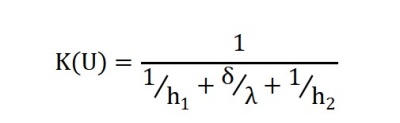
h in、hout are the convective surface heat-transfer coefficients on the two sides. Under JGJ/T 151, h in =8 W/㎡·K and hout =23 W/㎡·K. δ is the material thickness.
Example: U-value of a 6mm monolithic clear float glass pane, using λ=1W/m·K for glass

Shading coefficient (SC): the ratio of solar energy transmitted through the glass to that transmitted through 3mm clear glass. In practical terms, it indicates how strongly the sun can be felt behind the window.
Solar heat gain coefficient (g-value): the ratio of solar energy entering indoors through the glass to the energy that would enter through an unglazed opening of the same area. It is dimensionless.
The g-value equals direct solar transmittance plus secondary inward heat transfer.
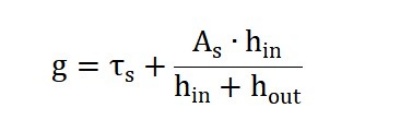
g: solar heat gain coefficient; τs: direct solar transmittance; As: direct solar absorptance; h in and hout: convective surface heat-transfer coefficients on the two sides
The solar heat gain coefficient of 3mm glass is 0.87. Therefore:
SC=g/0.87
Surface emissivity ε is a core thermophysical parameter that measures how strongly a surface releases energy by radiation. It is the ratio of the object’s actual radiated energy to that of an ideal black body at the same temperature, ranging from 0 to 1.
After understanding the energy distribution governing window and door insulation, two boundary definitions must be clear when selecting a system.
For thermal transmittance K(U), solar irradiance is set to “0”. Therefore, when the U-value is used to assess transparent materials, it evaluates only insulation against long-wave radiation.
The shading coefficient SC, or solar heat gain coefficient g, covers only the proportion of solar radiation at the Earth’s surface that passes directly through a transparent material. It therefore evaluates control of short-wave radiation.
Because glazing systems are transparent and provide daylight, they cannot be evaluated using K(U) alone, since solar radiation is excluded from its definition. SC alone is also insufficient.
System selection for a given region should combine both metrics. Thermal conductivity must not be used to evaluate a complete window or door system.
 English
 日本語
日本語 한국어
한국어 français
 Deutsch
 Español
 italiano
 русский
 português
 العربية
 Türkçe