Energy-efficiency rules keep getting tougher, and doors and windows are still the weak link in the building envelope. Pick the wrong system and you feel it in both the energy bill and indoor comfort. Then the spec sheet hits: is a lower K value always better? Can thermal conductivity tell you how the whole window performs? And how should you read SC?
This guide starts with the physics: where the energy comes from, how heat moves, and which numbers actually matter when choosing a window system.
First things first: what are we actually trying to block? Doors and windows mainly deal with two natural heat sources: surface solar radiation (short-wave) and terrestrial long-wave radiation.
Sunlight reaches the ground as electromagnetic waves from 280nm-2500nm. But the energy is definitely not split evenly:
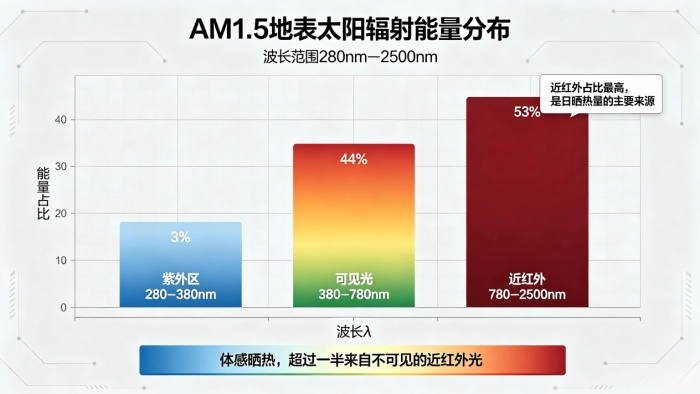
Ultraviolet: 280nm-380nm, only 3% of the energy.
Visible light: 380nm-780nm, the part we can see, 44% of the energy.
Near-infrared: 780nm-2500nm, a huge 53% of the energy.
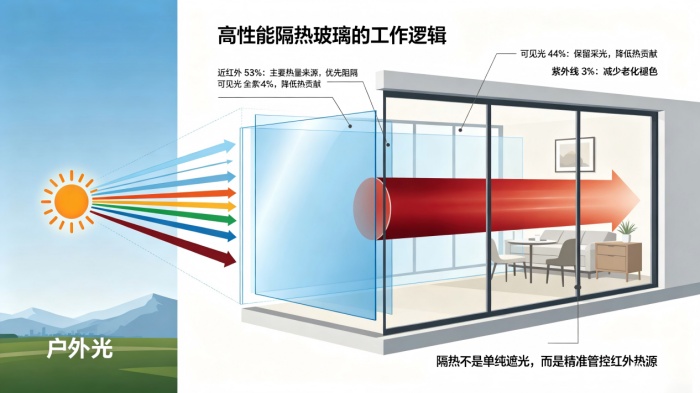
Basically: more than half of the "sun heat" you feel is invisible near-infrared. So a good insulating window has to deal with that 53% near-infrared load while still managing the 44% visible-light part.
Wavelength λ > 4500nm. This is mostly secondary radiation from surfaces that absorbed sunlight, plus heat from ground heating, combustion heaters, electric heaters, etc. Handling both long-wave radiation and surface solar radiation is a core job of insulating doors and windows.
Heat transfer through doors and windows is always moving, not static. Summer and winter work differently, and that matters when you choose a system.
In summer, the overall heat flow is from outside to inside.
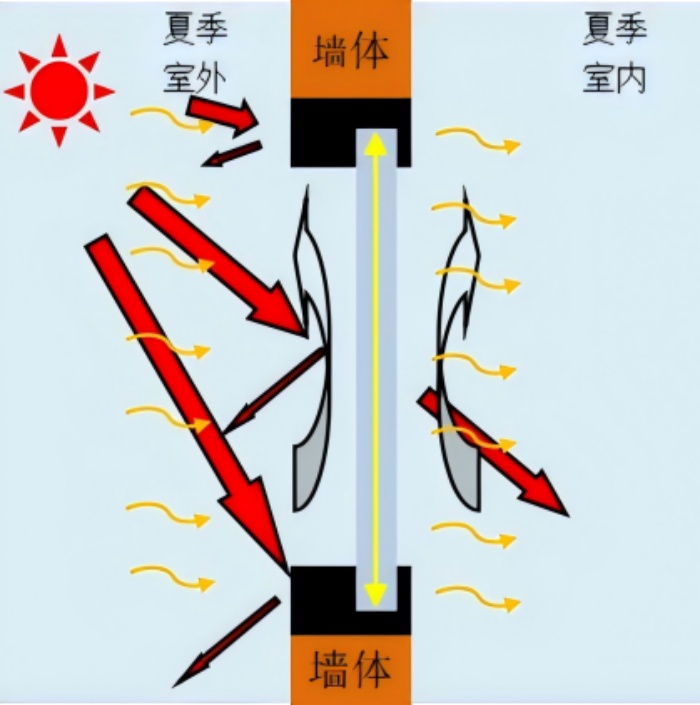
Frame: some heat bounces off, some gets absorbed. The outer frame heats up, conducts that heat inward, then dumps it into the room by radiation and convection.
Glass: sunlight hits the glass; some is reflected, some passes straight through, and some is absorbed. The absorbed part heats the glass, which then sends more heat indoors.
Environment: hot outdoor air keeps exchanging heat with the outside surface of the window, pushing indoor temperature up.
In winter, indoor heat is trying to escape while sunlight is still coming in through the glass. So you get heat loss and solar heat gain at the same time.
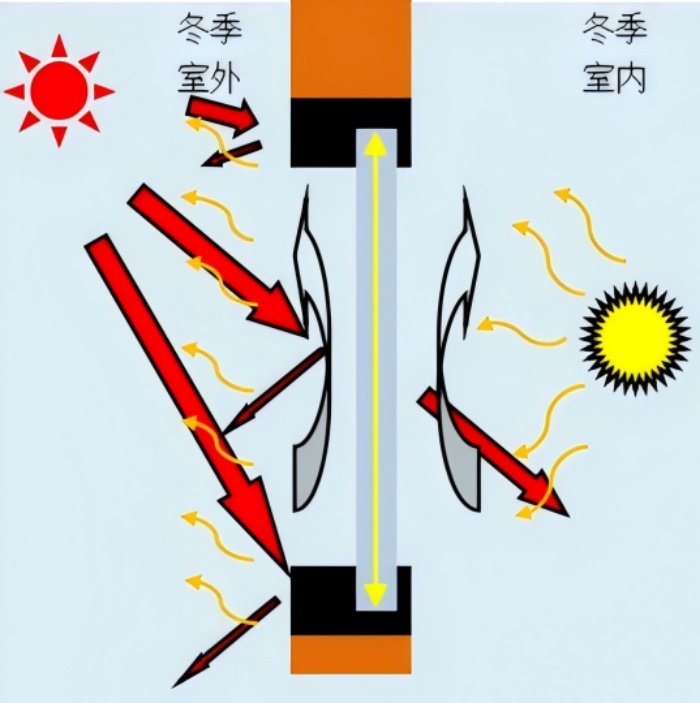
Frame: sunlight may warm the outside frame, but because indoors is warmer than outdoors, the net heat flow is still outward.
Glass: sunlight passes through and adds heat indoors, while indoor heat is also escaping through the window by radiation, convection, and conduction.
Basically:
Summer: the window acts like a hot plate feeding heat indoors. Your job is to stop that heat at the outside.
Winter: the window is more like a leaky funnel - indoor heat wants out, while sunlight works like a little power bank sending energy in. A good window blocks the leak without wasting useful solar gain.
You can't judge thermal performance by one number. These are the key metrics to look at:
These two get mixed up all the time.
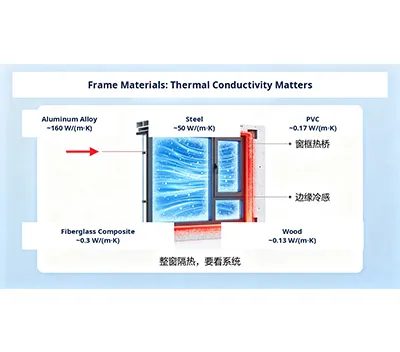
Thermal conductivity (λ): how easily heat moves through a material itself under steady-state conditions. For a 1m-thick homogeneous material with a 1K temperature difference, it is the heat passing through 1㎡ per unit time. Unit: W/m·K.
Thermal transmittance (K value/U value): how much heat passes through the whole building-envelope system under steady-state conditions when the air-temperature difference across it is 1K. It includes conduction, radiation, and convection. Unit: W/㎡·K.
Basically: λ is about the "fabric"; U value is about the finished "jacket" - design, thickness, gaps, everything. For doors and windows, look at the whole-system U value, not just the material λ.
These two are all about short-wave solar radiation.
Solar heat gain coefficient: the share of solar energy that makes it indoors through the glass versus the no-glass case. It includes direct transmission plus secondary heat transfer.
Shading coefficient (SC): compares solar energy through the actual glass with 3mm clear glass. Lower SC = less solar heat getting through.
In a real project, this is where people get tripped up: every parameter has a limit.
Thermal transmittance K(U): by definition, solar radiation is set to "0". So U value tells you how well the system handles long-wave, temperature-difference heat transfer - not how hard the sun is hitting it.
Shading coefficient SC: this only looks at the directly transmitted solar-radiation share, basically short-wave blocking.
Because windows are transparent and also need to provide daylight, no single number tells the whole story.
Mistake 1: only looking at U value. You miss solar heat gain, so you still don't know how much the room will bake in the sun.
Mistake 2: only looking at SC. You miss heat loss caused by the indoor-outdoor temperature difference.
Mistake 3: using thermal conductivity (λ) to judge the whole window. λ is a material property, not a full-system performance number.
Better move: use U value together with SC (or g value) and choose the combo that fits the local climate.
Solar radiation that reaches the Earth's surface, 280nm-2500nm, made up of ultraviolet, visible light, and near-infrared. This is one of the main natural energy sources a window needs to block or use.
Radiation with wavelength λ > 4500nm, mainly from surfaces re-radiating absorbed heat and from heating equipment.
A material property showing how easily heat conducts through a 1m-thick homogeneous material at a 1K temperature difference. Unit: W/m·K.
A whole-system thermal metric for doors and windows covering conduction, convection, and radiation. Unit: W/㎡·K. Lower = better insulation.
A dimensionless number comparing solar energy through the actual glass with 3mm clear glass. Lower = better solar shading.
The share of solar energy that gets indoors through the glass, including direct transmission and secondary heat transfer.
 English
 日本語
日本語 한국어
한국어 français
 Deutsch
 Español
 italiano
 русский
 português
 العربية
 Türkçe