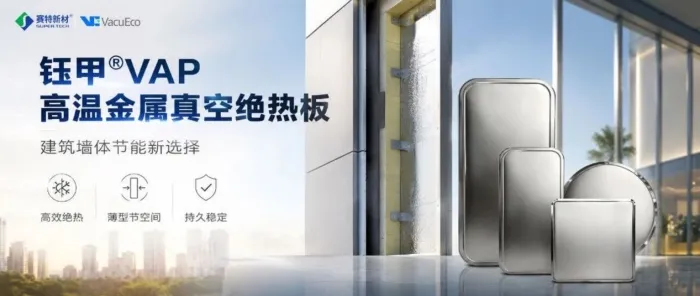
Summers keep getting hotter.
And the air conditioning in your building probably runs longer every year.
First instinct for most people: buy a more efficient AC, or upgrade the cooling system.
But everyone skips a step.
If outdoor heat keeps pushing in through the envelope, even the best AC is just hauling that same heat back out, over and over.
So as warming reshapes the thermal environment buildings face, it's worth rethinking something that used to sound simple:
Is “Keeping Heat In” Still the Whole Job for a Wall?

Traditionally, building insulation solved one thing:
Don't let indoor heat escape in winter.
Fair enough.
But the envelope doesn't only face winter.
There's summer.
Sun.
Hot air.
And outdoor temperatures that keep climbing.
Once it gets that hot outside, the wall isn't just stopping heat leaking out.
It has to slow the heat coming in.
Which is why picking materials on winter performance alone no longer covers it.
IPCC notes that climate change shifts heating and cooling demand, and that extreme heat raises building cooling loads. Envelope performance is a real part of climate adaptation.
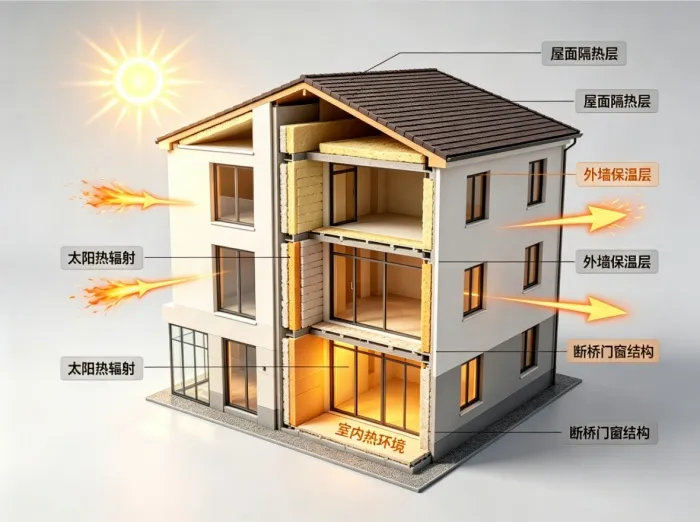
Picture a building as a container.
AC brings the temperature inside down.
But if the container keeps soaking up outside heat, the AC never gets a break.
So real building efficiency isn't only about the equipment.
It's about the envelope.
Walls.
Roof.
Windows and doors.
Together they set the heat exchange between a building and everything outside it.
One direction matters more and more:
Cut the unnecessary heat transfer before it ever gets inside.
IEA notes that space cooling demand keeps growing in the buildings sector, and that design and efficiency measures matter a great deal for controlling it.
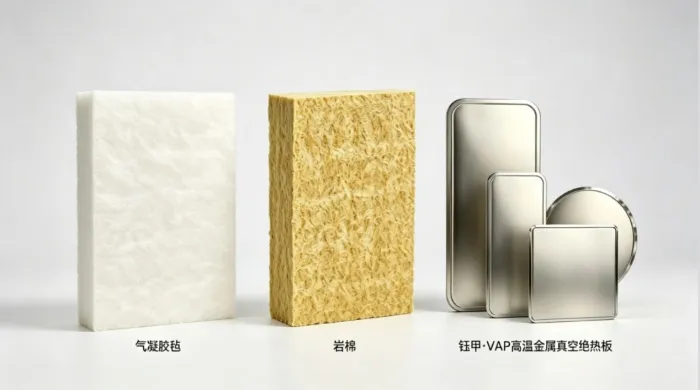
The answer isn't just:
The lower the thermal conductivity, the better.
The thicker, the better.
Real projects don't work like that.
There are at least four things worth rethinking.
Winter and summer are different problems, and the wall has to cut heat transfer in both.
Winter.
Keep indoor heat from leaking out.
Summer.
Keep outdoor heat from getting in.
So materials have to be judged across the whole year, not one season.
The classic move for better insulation is more thickness.
But wall space isn't infinite.
Retrofits especially.
The structure already exists.
The facade has limited room.
And you can't casually eat into usable floor space either.
So the direction shouldn't be:
Make it thicker.
It should be:
Get more insulation out of the thickness you've already got.
Which is one reason high-performance vacuum insulation is worth a look.
You can't pick wall insulation off a datasheet alone.
It has to fit the actual project.
For example:
What climate zone is the building in?
What's the wall build-up?
Where does the material sit?
Are there space constraints?
How does it get maintained later?
Does it need to work as a system with other materials?
High performance doesn't mean a material floats free of engineering reality.
Real material selection is a match between performance and structure.
Buildings aren't facing a single temperature problem.
They're managing a thermal environment all year.
Winter insulation.
Summer heat rejection.
Lower heating and cooling loads.
Better thermal comfort.
Long-term energy use kept under control.
So insulation stops being “a layer” and becomes part of the building's whole thermal strategy.
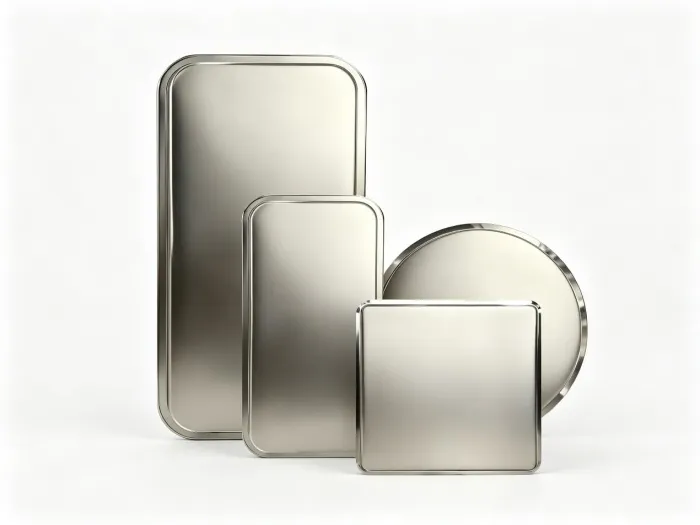
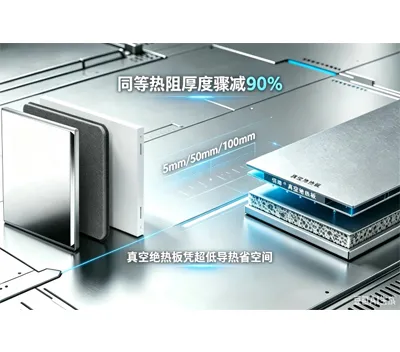
The vacuum insulation behind Super Tech Advanced Material's VAP high-temperature metal vacuum insulation panel is a different route from simply piling on thickness.
The core idea: use a vacuum structure to cut heat transfer inside the material itself.
VAP uses a 0.1mm SUS304 stainless steel preformed shell, filled with high-temperature-resistant core material, then sealed by laser welding to a SUS304 stainless steel film of the same thickness. That gives a tightly sealed vacuum structure with a flat surface, crisp edges and no wrinkling.
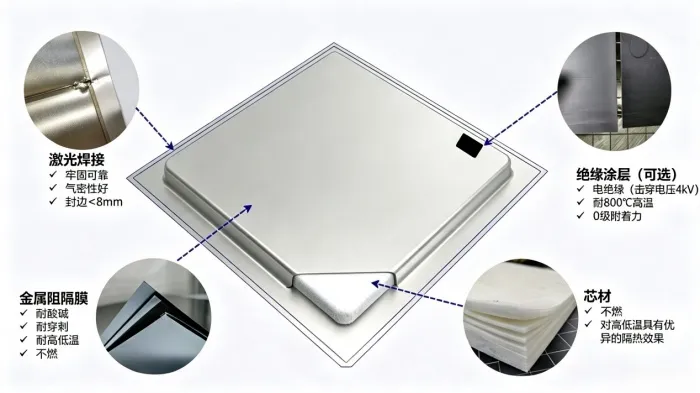
The product features a narrow welded edge seal and an extremely low leak rate, along with high- and low-temperature resistance, low thermal conductivity (≤0.0018W/(m・K)), long service life, puncture resistance, high compressive strength, and an A1 non-combustible rating.
For walls, the value lands in two places.
First, efficiency.
More thermal resistance out of limited structural depth.
Second, going thin.
When space is tight, you simply can't keep adding thickness.
In retrofits and space-constrained structures especially, thin high-performance insulation opens up options.
That said, a wall is a systems problem.
Applying VAP still needs design and validation against the structure, the climate, the installation method and the project's thermal requirements.
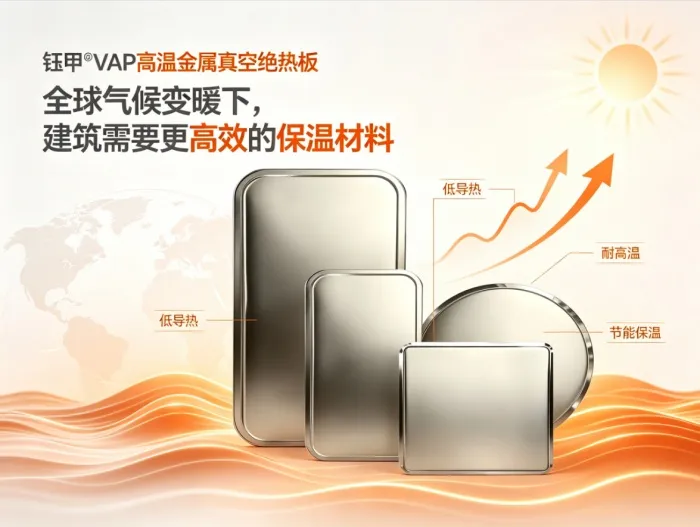
It's letting less heat in to begin with.
Under global climate change, that question keeps getting more relevant.
Building efficiency isn't just swapping in better equipment.
It's re-examining the building itself.
IEA's building efficiency analysis shows the sector accounts for a major share of global energy demand, and that improving efficiency is still a key way to bring that demand down.
For Super Tech Advanced Material, bringing VAP into the building efficiency conversation isn't just adding one more insulation option to the shelf.
It's taking years of vacuum insulation work and rethinking it against how building thermal environments are actually changing.
What Supertech VAP is really after: using high-performance vacuum insulation to give space-constrained envelopes a new way to insulate.
Building efficiency isn't a one-off purchase order.
It shapes how the building runs for decades.
With the climate warming, what you specify today affects how the building copes with heat, energy use and change later on.
A material's value comes back to the long run.
Back to the building itself.
Back to energy management over a much longer horizon.
That's probably the part actually worth discussing.
Thermally, both are about cutting heat transfer. In practice, insulation usually refers to keeping indoor heat in during winter, while heat rejection describes keeping outdoor heat out in summer. Material selection should still follow the project's thermal design requirements.
Not necessarily.
More thickness raises the thermal resistance of the layer, but a project also has to handle space, structure, installation and overall thermal design. Where space is tight, thin high-performance materials can earn their place.
That's not the right way to read it.
Supertech VAP sits on the high-performance vacuum insulation route, and applying it needs assessment against building type, structural design, climate and engineering requirements. Different projects suit different material strategies.
For wall efficiency, high-performance insulation, and matching materials to specific conditions, we're happy to get into the technical detail around your structure and thermal requirements.
IPCC background on climate change affecting building heating and cooling demand, and on heat raising cooling loads
IEA analysis on growing global space cooling demand
UNEP background on emissions from the buildings and construction sector and the efficiency transition
Background on GB 55015-2021, the General Code for Energy Efficiency and Renewable Energy Application in Buildings, coming into force
UNEP's 2025 Global Cooling Watch says that on the current path, global cooling demand could more than triple by 2050. UNEP's 2026 buildings report also places buildings and construction at the centre of global climate action.
IPCC
International Energy Agency (IEA)
UN Environment Programme (UNEP)
China's national mandatory engineering construction standards on building energy efficiency
 English
 日本語
日本語 한국어
한국어 français
 Deutsch
 Español
 italiano
 русский
 português
 العربية
 Türkçe