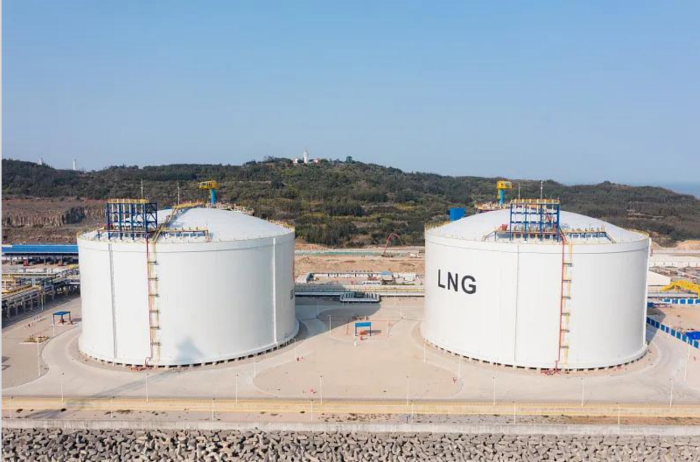
At coastal LNG receiving terminals, the massive storage tanks stand like fortresses guarding energy security. Storing LNG at -162℃ safely for decades takes far more than a strong shell.
Today, we look inside this steel giant to see how its structure drives the extreme requirements for cryogenic insulation—and why a seemingly soft elastic blanket is critical to system safety.
Large atmospheric LNG storage tanks generally use a double-wall, single-containment design with a suspended deck above the inner tank and a domed outer-tank roof. The tank stands on a reinforced-concrete foundation slab supported by concrete columns about 15000mm high, providing strong ventilation and moisture protection.
A cross-section shows four main structural sections:
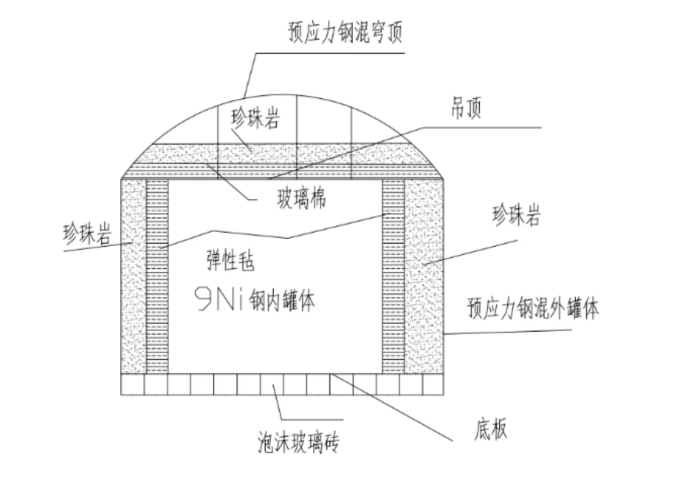
Stores LNG at -162℃.Because of the extreme cold, it is usually made from low-temperature austenitic stainless steel SA240-304 or 9%Ni steel for large tanks. All transfer lines enter and exit through the roof, and submerged pumps move the LNG. The shell requires no openings, minimizing leakage risk.
Built from low-temperature-resistant metal or concrete. If the inner tank develops a minor leak, gas is contained in the annular space and liquid is retained, providing secondary protection.
Suspended above the inner tank, it does not carry internal pressure or flash-vapor pressure—only the weight of the insulation. It is covered with 700mm of low-density glass wool with low thermal conductivity.
The base uses about 800mm of foam-glass blocks and high-strength load-distribution boards to block heat ingress. The annular space between the inner and outer tanks is mechanically filled on site with expanded perlite at a fill factor of up to 1.6.
The annular space between the two tanks is where the real engineering challenge lies.
A storage tank is not static. When LNG at -162℃ enters, the metal inner tank contracts sharply inward. The perlite in the annular space then settles under gravity and fills the gaps created by the movement.
When the tank warms or the inner tank expands outward, the compacted perlite has nowhere to move and exerts heavy lateral pressure on the outer wall of the inner tank. Temperature cycling repeatedly amplifies this pressure and can buckle or dent the thin-walled inner tank.
To withstand these alternating thermal stresses, the insulation must meet five critical requirements:
Ultra-low thermal conductivity: For cryogenic service, thermal conductivity must not exceed 0.08 W/(m·K) (generally ≤0.12W/m·K for thermal insulation).
Lower values reduce cold loss.
Extremely low water absorption and moisture uptake: Air has very low thermal conductivity at room temperature, while water reaches 0.599 W/(m·K) at 20℃—more than 20 times higher. Once the material absorbs water, its insulation performance drops sharply.
Temperature compatibility and low permeability: The insulation’s thermal expansion coefficient should be close to that of the inner-tank steel to prevent cracking from excessive thermal stress. It must also have extremely low water-vapor permeability.
Mechanical stress buffering (high resilience): The material must absorb the lateral pressure from expanded perlite like a sponge, reducing stress on the inner-tank wall plates.
Fire resistance and corrosion protection: Use highly fire-resistant material whenever possible (A1 non-combustible), and ensure it does not corrode metal during long-term contact.
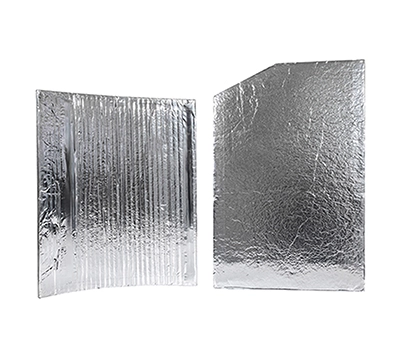
To address the annular-space challenges and the strict demands of cryogenic service, Super Tech developed LNG elastic blanket, a high-performance insulation material designed specifically for LNG storage tanks.
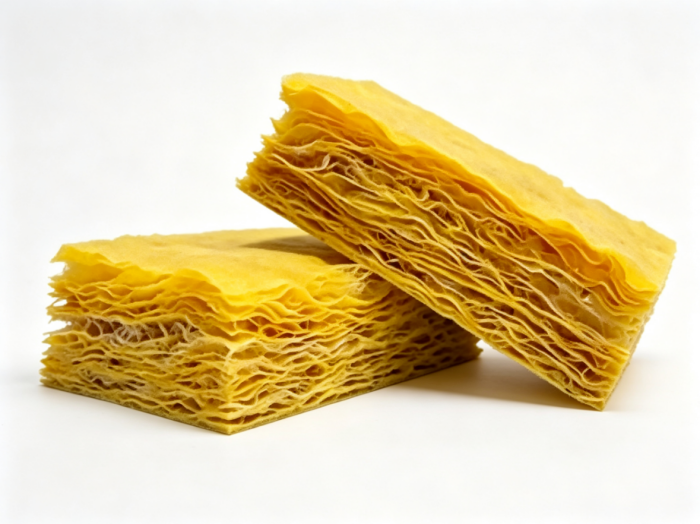
Made from glass fiber, the product uses a special process to randomly lay fine glass fibers into a web and bond them with a specially formulated resin.
To address the annular-space challenges and the strict demands of cryogenic service, Super Tech developed LNG elastic blanket, a high-performance insulation material designed specifically for LNG storage tanks.
Made from glass fiber, the product uses a special process to randomly lay fine glass fibers into a web and bond them with a specially formulated resin.
Developed as a next-generation core material for cryogenic LNG storage tanks, VacuEco draws on the expertise of its parent company, Fujian Super Tech Advanced Material Co., Ltd., using a specialized air-laid process to randomly distribute ultrafine glass fibers and bond them with a dedicated resin, creating a high-resilience, highly stable LNG tank elastic blanket.
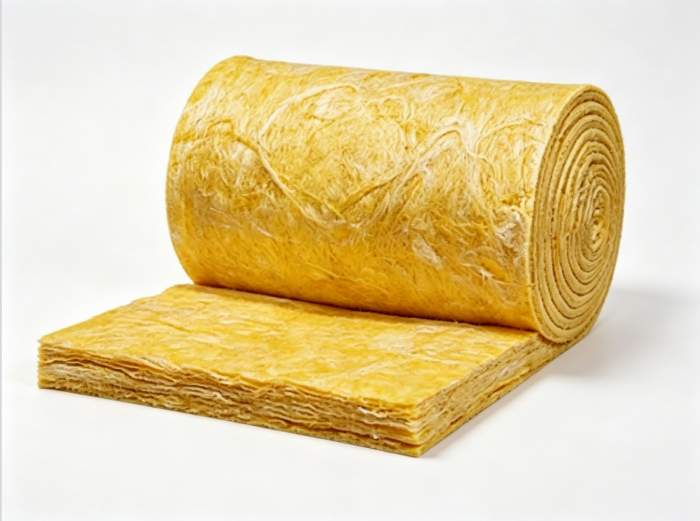
The following measured data shows its performance:
Ultra-low thermal conductivity at -165℃: Measured at 0.012 W/(m·K), significantly improving LNG storage efficiency.
High resilience coefficient: 0.48, above the standard requirement of 0.44, allowing it to absorb lateral pressure throughout decades of tank service and prevent inner-tank deformation or buckling.
High tensile strength: ≥ 18 kPa; tightly bonded fibers prevent collapse or slippage after installation and maintain uniform thickness.
Low moisture content and fire resistance: Moisture content ≤ 0.4%, with A1 non-combustible performance, preventing freezing and frost from damaging the fiber structure in cryogenic service.
Wide operating temperature range: -200℃ ~ +200℃.
Mass production reduces costs: For years, elastic blankets used in large LNG terminal storage-tank insulation systems have depended heavily on overseas suppliers, resulting in high procurement costs and long lead times. Through independent technology development, Super Tech has achieved domestic mass production. This significantly reduces total procurement costs for project owners and strengthens supply-chain security for China’s cryogenic energy infrastructure.
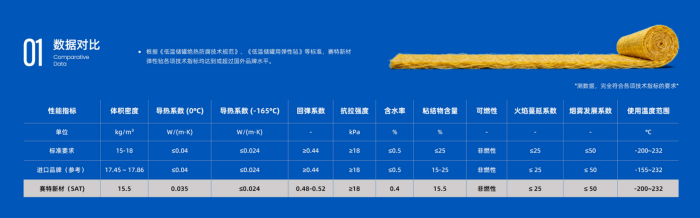
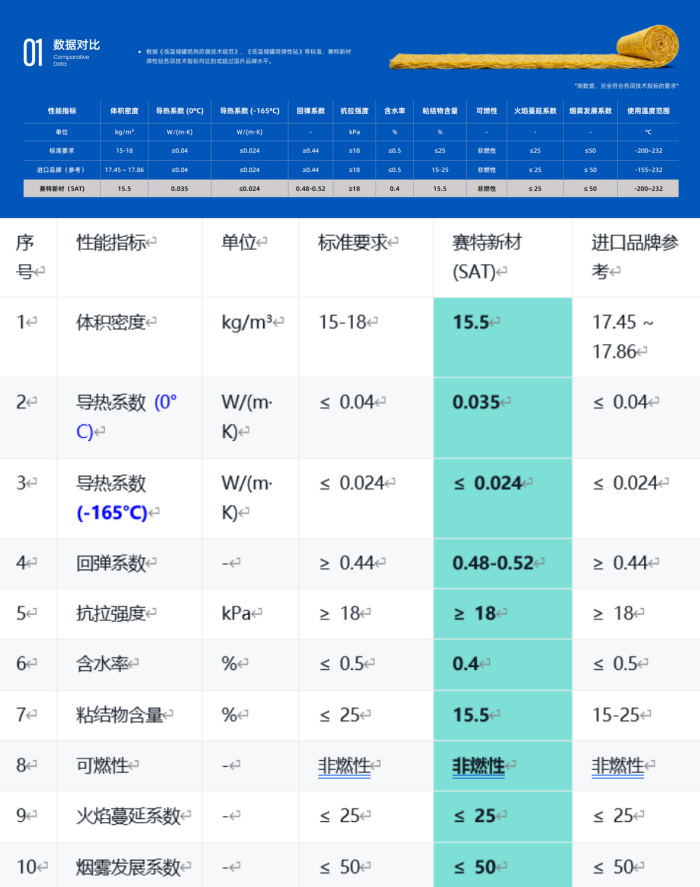
Under standards including the Technical Specification for Thermal Insulation and Corrosion Protection of Low-Temperature Storage Tanks, Super Tech elastic blanket meets or exceeds a famous brand performance across all key specifications.
 English
 日本語
日本語 한국어
한국어 français
 Deutsch
 Español
 italiano
 русский
 português
 العربية
 Türkçe