On the eve of drawing finalised drawings.
Flipping to the window section in the energy-efficiency calculation report —
The overall window heat-transfer coefficient is teetering right at the threshold.
Exterior wall insulation has been added layer upon layer, and the window-to-wall ratio has also been pushed down to the code-specified limit.
Yet the overall window U-value still falls just short of the target.
The familiar fix comes into play: Switch to thicker glass? Add more insulating cavities?
There is some performance gain, but costs and self-weight surge sharply.
Meanwhile, thermal bridging in the frame profiles remains largely unaddressed.
Many projects stop here, settling for "good enough to pass inspection".
But let us reframe the problem: The overall window U-value is never a performance metric for glass alone.
The bucket-effect applies perfectly to windows.
Even if glass is optimised to its physical limit, inadequate profiles will render all efforts futile.
If both glass and profiles perform well yet edge sealing permits excessive heat loss, the window still underperforms.
Two common pitfalls exist in conventional solutions:
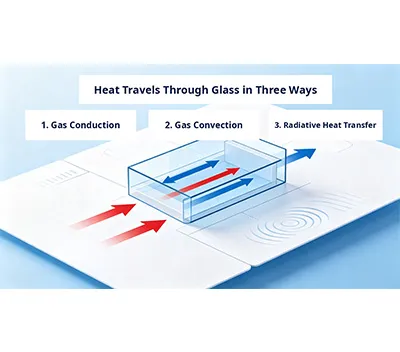
Air (even when replaced with argon gas) still conducts heat and sound. There is a physical lower bound for the centre-of-glass heat-transfer coefficient.
Aluminium boasts a thermal conductivity of 237 W/(m·K), hundreds of times higher than composite thermal-break profiles.
No matter how high-performance the glass is, heat keeps escaping outdoors through the metallic frame perimeter.
Performance ceilings encountered with single-component upgrades stem essentially from neglecting the other two system components.
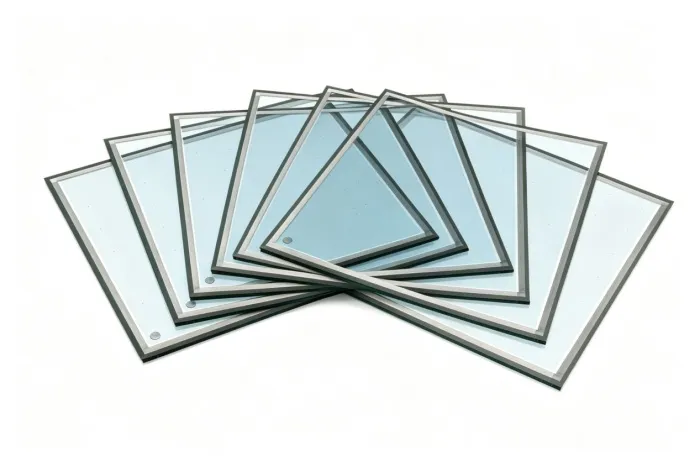
A vacuum gap of approximately 0.5 mm is created between two glass panes. Combined with low-emissivity coatings and proprietary alloy vacuum sealing layers, full-perimeter welding is completed under vacuum conditions to form a long-term stable static vacuum system. Heat conduction loses its transfer medium at source.
Key performance parameters:
Indicator | Value |
Bending strength | Exceeding 1 GPa |
Thermal conductivity | 0.114-0.34 W/(m·K) (vs. 237 for aluminium) |
Fire integrity | >= 1 hour |
Density | ~ 3/4 of aluminium profiles |
(The lower density is a hidden advantage for curtain-wall projects sensitive to self-weight.)
In conventional equal-pressure sealing structures, heat travels along a straight-line path at edges, causing prominent thermal bridging.
Labyrinth-type offset sealing greatly extends heat-transfer pathways via structural dislocation. Performance is achieved not merely through material properties, but by forcing heat to take a "detour".
For vacuum-insulated insulating composite glass with identical glass configurations:
Sealing Solution | Edge U-Value | Overall U-Value |
Equal-pressure sealing | 1.64 | 0.65 |
Labyrinth-type sealing | 1.36 (~17 % reduction) | 0.58 |
(Units: W/(m²·K))
Merely switching the sealing structure further lowers the overall U-value.
When glass and profiles are combined into full windows, the VIG® Series-60 complete windows offer four standard configurations covering cost-effective to ultra-low-energy-performance requirements:
Window Assembly | Frame | Edge (65 mm) | Centre-of-Glass | Overall |
Painted aluminium profile + double-silver low-e insulating glass | 6.37 | 2.26 | 1.48 | 3.1 |
Fibre-reinforced profile + double-silver low-e insulating glass | 2.40 | 1.74 | 1.48 | 1.81 |
Painted aluminium profile + double-silver low-e vacuum glass | 6.72 | 1.52 | 0.37 | 2.51 |
Fibre-reinforced profile + double-silver low-e vacuum glass | 2.61 | 1.23 | 0.37 | 0.89 |
(Units: W/(m²·K), test specimen: 1200 × 600 mm)
Look at the last row:
Fibre-reinforced profiles paired with double-silver low-e vacuum glass achieve an overall U-value of 0.89 W/(m²·K) — meeting window energy-efficiency requirements for passive-house and green-building-certified projects.
Compared with the first configuration, the overall U-value differs by more than a factor of three.
For one identical window opening, different design schemes yield vastly different calculation-report outcomes.

For engineering contractors, advanced technology means little without assured supply and valid qualifications:
Over 180 patents in total;
Dual international environmental certifications: RoHS and REACH;
One of the compiling organisations for Technical Specification for Application of Vacuum Glazing in Buildings (T/CECS 2090-2025).
Custom prototyping for individual projects is available, as is stable mass-scale delivery for large-volume developments.
Vacuum glazing paired with composite thermal-break profiles excels in system windows, curtain walls, passive houses and sunrooms. Two project categories merit special attention:
Conventional aluminium profiles tend to develop surface chalking and corrosion. Composite thermal-break profiles deliver superior ageing resistance and weatherability, lowering long-term maintenance costs.
Profiles face severe weathering challenges here, where composite materials demonstrate robust performance.
For building owners, this means compliance is not only achieved at hand-over, but thermal performance of the facade remains valid decades later.
Reach out to the SuperVIG® technical team if you are working on:
Passive-house, green-building or high-performance curtain-wall projects comparing window system alternatives;
Window-to-wall schemes stuck at marginal energy-efficiency compliance;
Calculation of overall heat-transfer coefficients for multiple configuration combinations.
Share your window dimensions and target energy-efficiency grade. Our team can assist in calculating overall heat-transfer coefficients for different set-ups, balancing performance and project cost.
Competition within the window-and-door industry is shifting from isolated component specifications toward complete system solutions.
Passive-house compliance opens only to system-oriented problem-solvers.
Predictable U-values stem from every carefully selected material layer. Successful inspections result from coherently interconnected system design.
 English
 日本語
日本語 한국어
한국어 français
 Deutsch
 Español
 italiano
 русский
 português
 العربية
 Türkçe