Last time, we broke down the heat-transfer paths and the main formulas behind insulating glass. Now we're going straight into the numbers: real test data, real calculations, and the selection rules you actually need.
Calculation basis: the manufacturer measured the samples with a spectrophotometer and used spectral integration formulas to calculate the spectral constants for each pane.
Sample 1: clear glass (CSG 6mm clear glass)
Tsol1 | Tsol2 | Rsol1 | Rsol2 | Tvis1 | Tvis2 | Rvis1 | Rvis2 | ε1 | ε2 |
0.822 | 0.822 | 0.074 | 0.074 | 0.897 | 0.897 | 0.081 | 0.081 | 0.84 | 0.84 |
Sample 2: Low-E glass (CSG LB69-1_6 double-silver coated glass)
Tsol1 | Tsol2 | Rsol1 | Rsol2 | Tvis1 | Tvis2 | Rvis1 | Rvis2 | ε1 | ε2 |
0.325 | 0.325 | 0.301 | 0.419 | 0.669 | 0.669 | 0.091 | 0.053 | 0.84 | 0.033 |
Sample 3: solar control coated glass (CSG CNY129_6, added for a clearer comparison)
Tsol1 | Tsol2 | Rsol1 | Rsol2 | Tvis1 | Tvis2 | Rvis1 | Rvis2 | ε1 | ε2 |
0.292 | 0.292 | 0.137 | 0.239 | 0.322 | 0.322 | 0.17 | 0.214 | 0.84 | 0.664 |
Calculated with LBNL Window 7.2 under the boundary conditions in JGJ/T 151:
Tvis=0.603,g(SHGC)=0.363,SC=0.417,LSG=1.66,K(U)=1.66 W/㎡·K
Low-E glass results:
Tvis=0.603,g(SHGC)=0.363,SC=0.417,LSG=1.66,K(U)=1.66 W/㎡·K
Tv=0.294,g(SHGC)=0.35,SC=0.403,K(U)=2.51 W/㎡·K,LSG=0.84
After switching to solar control coated glass:
Tv=0.294,g(SHGC)=0.35,SC=0.403,K(U)=2.51 W/㎡·K,LSG=0.84
What the comparison shows:
With similar SC values, the insulating-glass system using solar control coated glass has only about half the LSG of the Low-E system. Why? Low-E lets in much more visible light while reflecting more infrared. Solar control glass gets to a similar SC mostly by cutting visible light.
Basically:
Same SC, very different result. Low-E has much higher visible-light transmittance(0.603 vs. 0.294)and a lower K(U). More daylight gets in, more infrared gets kicked back out. Overall, Low-E wins.
Change one variable, freeze everything else - that's the cleanest way to see how much each parameter actually moves thermal performance.
When emissivity goes up, K(U) goes up too:
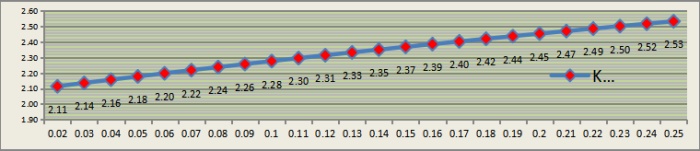
At ε=0.02, K(U)=2.11
At ε=0.15, K(U)=2.39
At ε=0.25, K(U)=2.53
Note: these chart values are assumed parameters used only to isolate the effect of emissivity on K(U). In a real project, emissivity would not change by itself while every other glass parameter stays fixed.
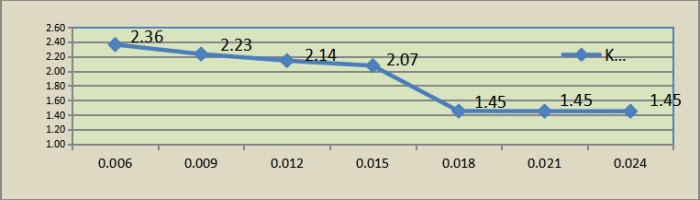
As the gap gets thicker, air convection drops and K(U) falls. Once the gap reaches 12mm<d<16mm, the cavity flow moves from laminar toward transitional flow. Go thicker than that and K(U) barely improves. In practice, 12mm is the sweet spot and the common engineering choice.
D(mm) | 6 | 9 | 12 | 15 | 18 | 21 | 24 | 27 |
K(U) | 2.32 | 1.86 | 1.66 | 1.69 | 1.74 | 1.771 | 1.80 | 1.80 |
Lower gas thermal conductivity = lower K(U).
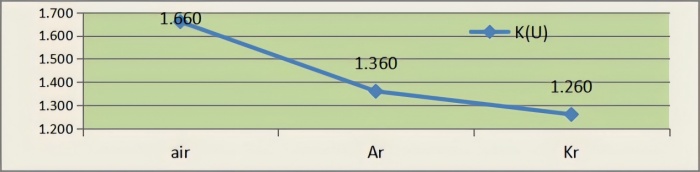
Dry air: K(U) = 1.66
Pure argon: K(U) = 1.36
Pure krypton: K(U) = 1.26
Bottom line: coated-glass emissivity, gas-gap thickness, and gas composition all work together to set the system's thermal performance - its K(U) value.
Basically:
Three clean takeaways: 1. lower coating emissivity = lower K(U); 2. 12mm is the best-value gas gap, because going thicker changes the flow regime and stops giving meaningful K(U) gains; 3. a lower-conductivity inert gas can push K(U) down even further.
All three glass options are from CSG.
Spectral data:
Glass | Solar Parameters(Solar) | Visible Light(Visible) | Emissivity(ε) | Notes | |||||||
Tsol1 | Tsol2 | Rsol1 | Rsol2 | Tvis1 | Tvis2 | Rvis1 | Rvis2 | ε1 | ε2 | ||
SJ50s-6 | 0.228 | 0.228 | 0.481 | 0.491 | 0.583 | 0.583 | 0.083 | 0.030 | 0.84 | 0.024 | Triple-silver |
LB69-6 | 0.345 | 0.345 | 0.392 | 0.424 | 0.679 | 0.679 | 0.099 | 0.060 | 0.84 | 0.033 | Double-silver |
0.434 | 0.434 | 0.179 | 0.223 | 0.624 | 0.624 | 0.103 | 0.032 | 0.84 | 0.141 | Single-silver | |
The system uses 6Low-E+12A(air)+6C and is installed at 90° to the vertical plane. Here are the calculated optical results for the three coated-glass options:
Glass | Tv | Asol | g(SHGC) | SC | LSG |
0.524 | 0.318 | 0.260 | 0.3 | 2.02 | |
0.612 | 0.295 | 0.373 | 0.43 | 1.64 | |
CEB14-60 | 0.561 | 0.428 | 0.459 | 0.53 | 1.22 |
All three insulating-glass systems sit in the medium visible-light-transmittance range. Solar blocking ranks: triple-silver > double-silver > single-silver. Triple-silver has the lowest surface emissivity and the strongest reflection in the near-infrared range(780nm-2500nm), with double-silver next. At the same time, it lets more visible light through, which gives it the best LSG.
Summer Relative Heat Gain(RHG)at a Glance:
Glass Type | SJ50s-6 | LB69-6 | CEB14-60 |
Relative Heat Gain RHG | 201 W/㎡ | 284 W/㎡ | 348W/㎡ |
RHG gives a quick read on overall summer heat-control performance. Once U value and SC are set, the option with higher visible-light transmittance gives you the better combo of daylight + insulation.
Basically:
All three are medium-transmittance glass, but triple-silver has the lowest emissivity and strongest near-infrared reflection. That gives it the best LSG and the lowest RHG. More daylight, less solar heat, lower cooling demand.
This makes a big difference to the whole system. It cuts mid- and far-infrared heat transfer, helping lower K(U), and it also reflects near-infrared solar energy, reducing total solar transmission.
From the data above, 12mm is the preferred gap. Argon gives the best cost/performance, while xenon gives the best performance. The final thermal metric is K(U).
Solar energy is mainly visible light + near-infrared. Visible light makes up 44% of the solar-spectrum energy. As a rule of thumb, south-facing windows in southern regions can use Low-E glass with 45-60% Tv. Shaded sides can use high-transmittance Low-E to keep daylight up. Where there is no direct sun, incoming energy is mainly far-infrared, so solar transmittance is not the right insulation metric. And yes: solar control coated glass on a shaded façade does basically nothing for thermal insulation.
Near-infrared is 53% of solar-radiation energy. For summer heat control in southern regions, you want as little of it indoors as possible. Zero is unrealistic, so lower-emissivity glass is the better way to boost near-infrared blocking.
Total solar transmittance sets how much solar heat the insulating-glass system gains. Lower g is better for heat control, but push g too low and you can kill visible light too. So first meet the daylight requirement, then go for the lowest practical g.
Use LSG to optimize the pick: if Tv is fixed - for example 55% - then LSG=Tv/g=0.55/g. Same numerator, so the higher the LSG, the less solar energy gets indoors.
Basically:
Quick selection checklist:
Pick low-emissivity coated glass to lower both K(U) and solar transmission.
Use a 12mm gas gap. Argon is the best value; xenon gives the best performance.
Sun-facing side: Low-E with Tv 45-60%. Shaded side: high-transmittance Low-E. Don't use solar control coated glass on a shaded side - it won't give you meaningful insulation.
For thermal optimization, check LSG. With Tv fixed, higher LSG = less solar energy indoors.
*Reference standards: JGJ/T151, GB/T2680, ISO15099, etc.*
 English
 日本語
日本語 한국어
한국어 français
 Deutsch
 Español
 italiano
 русский
 português
 العربية
 Türkçe