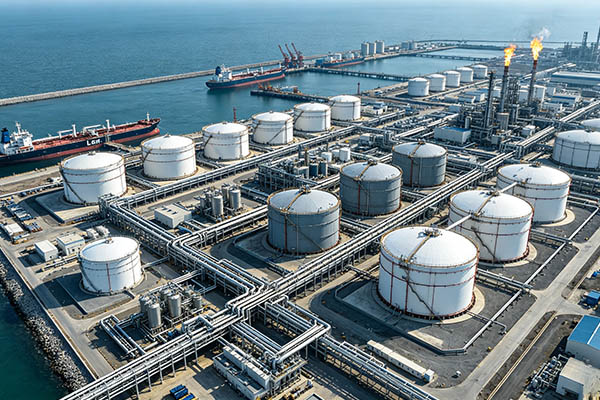
Do You Have the Same Concern?
Whenever we introduce vacuum insulation technology to LNG tank engineers, we hear almost the same question: “What happens if a vacuum insulation panel loses vacuum in a large storage tank?”
It is a valid question. It does challenge the technology by examing reliability.
This article provides a clear answer.

VacuEco VPU may be unfamiliar to many readers.
VPU, formally called a metal-envelope vacuum insulation panel–polyurethane composite module [“VIP + PIR/PU Composite Insulation Panel”], is a new insulation material developed by VacuEco, a Super Tech company.
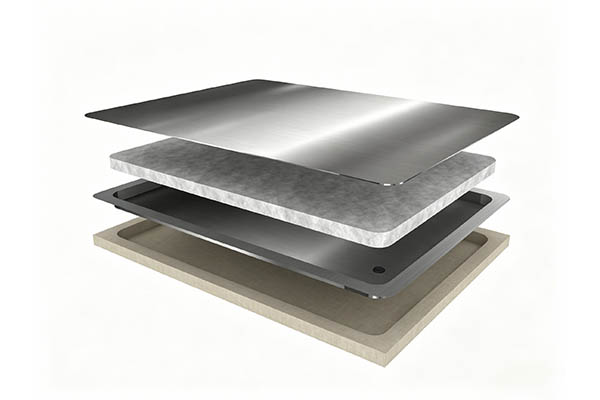
At its core is a vacuum insulation panel (VIP) sealed in a high-barrier 304 stainless steel envelope. The vacuum greatly reduces gas conduction and convection; polyurethane foam is then added to form a modular product suitable for engineering applications.
Put simply: VacuEco VPU = vacuum insulation core + metal protective envelope + polyurethane composite module—a high-performance insulation panel with metal armor.
Back to the central question: can large LNG storage tanks really use vacuum insulation panells?
Yes. VacuEco’s solution is specifically designed to address the concern of puncture and leakage.
The key is a distributed design.
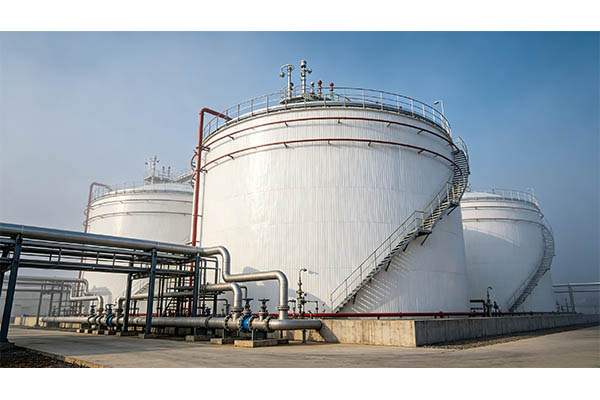
A 270,000m³ LNG storage tank has a total surface area of about 25,328m², equivalent to roughly 3.5 football pitches.
With modular VPU installation, one tank may use more than 10,000 independent modules.
The system therefore does not depend on one large vacuum chamber. It consists of more than 10,000 independent modules.
Even in the unlikely event that a few modules lose some vacuum, the entire insulation system will not fail.
It is like a wall built from thousands of bricks: a few imperfect bricks do not compromise the whole wall.
VacuEco VPU does not work alone. It complements existing insulation systems:
In full-containment tanks, VacuEco VPU works with conventional materials such as perlite: the conventional insulation provides baseline reliability, while VPU provides high-performance thermal enhancement;
In membrane tanks, VacuEco VPU is combined with PU or PIR insulation modules to create a higher-performance composite insulation structure.
Even with uncertainties over long-term service, the overall insulation system retains a stronger safety margin.
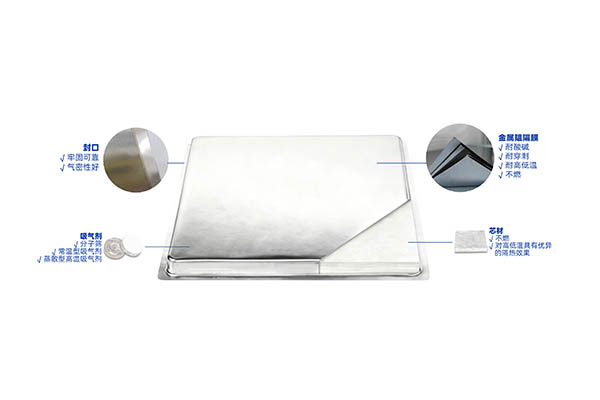
VacuEco VPU uses a high-barrier 304 stainless steel envelope, offering several advantages over conventional flexible-film VIPs:
Comparison | Conventional Flexible-Film VIP | VacuEco Metal-Envelope VPU |
Mechanical Protection | Limited; easily damaged | Strong; protected by a metal envelope |
Gas Barrier | Moderate | Excellent; 304 stainless steel |
Low-Temperature Suitability | Limited | Excellent; suitable for -162°C |
Vacuum Retention Life | Shorter | Theoretically up to 80 years |
Combined with high-performance getters and laser-welded edge seals, it can maintain a stable vacuum over the long term, with a theoretical vacuum retention life of up to 80 years.
For customers, these are not minor technical details. They are the basis for confidence.
In LNG storage, innovation cannot come at the expense of reliability.
VacuEco VPU is not intended to replace existing systems aggressively. It adds an efficient, safe, and engineerable insulation layer to established insulation systems.
It demonstrates that:
Vacuum insulation can be used in large storage tanks;
High-performance insulation can include redundancy;
New technology can follow the reliability principles of energy engineering.
For large LNG storage tanks, a worthwhile new technology must be high performing and reliable.
VacuEco provides that balance.
Want a project-specific VPU application proposal?
Message us or use the contact details at the end. The Super Tech technical team will provide tailored support.
LNG terminology can be highly technical. Here are the key terms used in this article
Term | Definition |
LNG | Liquefied Natural Gas: natural gas cooled to about -162°C until it becomes liquid. Its volume is reduced by about 600 times, making storage and transport easier. |
VPU | A metal-envelope VIP and polyurethane composite module developed by Super Tech. It combines a vacuum insulation panel (VIP) with polyurethane to provide high-performance thermal insulation. |
VIP | Vacuum Insulation Panel: a high-performance insulation material that uses a vacuum to greatly reduce thermal conductivity. |
BOR | Boil-Off Rate: the percentage of LNG that naturally evaporates from a storage tank each day due to heat ingress. It is a key measure of tank insulation performance. |
BOG | Boil-Off Gas: gas generated when LNG evaporates due to heat ingress. It must be handled through compression, recondensation, or other processes. |
Full-Containment Tank | A large LNG storage tank with a 9% nickel-steel inner tank and a prestressed-concrete outer tank. It is the most common LNG tank type in China. |
Membrane Tank | A newer LNG storage tank design with an approximately 1.2mm corrugated stainless steel membrane lining and a prestressed-concrete load-bearing outer structure, requiring less steel. |
Perlite | A conventional LNG tank insulation material with a thermal conductivity of about 30~40mW/m·K, widely used to fill the annular space of full-containment tanks. |
Thermal Conductivity | A measure of how readily a material transfers heat. Lower values indicate better insulation. Unit: mW/m·K. |
Thermal Bridge | A local area in an insulation structure with relatively high thermal conductivity. It increases local heat ingress and must be carefully controlled in insulation design. |
Getter | A functional material inside a vacuum insulation panel that absorbs residual gases and helps maintain a stable vacuum over the long term. |
Recondensation | The process of compressing and reliquefying BOG. It is one of the main BOG treatment methods at LNG terminals. |
Distributed vacuum insulation makes upgrades to large LNG tank insulation more reliable.
Follow us or send us a message for technical information or project support.
 English
 日本語
日本語 한국어
한국어 français
 Deutsch
 Español
 italiano
 русский
 português
 العربية
 Türkçe


![[Technical Series] Insulating Doors & Windows 101 (Part 3): Real Data + How to Pick the Right Glass](/uploads/image/20260814/real-data-how-to-pick-the-right-glass00.webp "[Technical Series] Insulating Doors & Windows 101 (Part 3): Real Data + How to Pick the Right Glass")